Tuesday, May 18, 2010


Monday, May 17, 2010
International Day Against Homophobia 2010
In some parts of Britain there's been a disturbing rise in the number of homophobic hate crimes.
What do we really think, as a nation, of same-sex relationships?
That was what Welsh rugby player, Gareth Thomas wanted to find out on Tonight an ITV programme broadcast at 7.30pm last Thursday, and introduced by former Newsround presenter Julie Etchingham.
Julie: Tonight. We like to think we're a tolerant nation, but are we really? .... How easy is it to change hearts and minds?
A survey for the programme showed that 1 in 4 people in Britain thought the sight of a same sex couple holding hands offensive, and nearly half would be offended if a gay couple kissed in public.
Nathaniel and Nick took part in an experiment, in which they walked hand-in-hand down a street in Wigan -
Emma Kenny (psychologist): The thing I found most shocking about today is that, whilst I found lots of people making homophobic comments walking past our couple, very few of them were willing to go on camera and, for the record, state them. And that represents to me an undercurrent of feelings that are hidden, and that's the problem. Because when things are hidden they can't get dealt with.
Tonight - Afraid to be Gay is available to view on the ITVplayer for another 3 weeks or so.
In some parts of Britain there's been a disturbing rise in the number of homophobic hate crimes.
What do we really think, as a nation, of same-sex relationships?
That was what Welsh rugby player, Gareth Thomas wanted to find out on Tonight an ITV programme broadcast at 7.30pm last Thursday, and introduced by former Newsround presenter Julie Etchingham.
Julie: Tonight. We like to think we're a tolerant nation, but are we really? .... How easy is it to change hearts and minds?
A survey for the programme showed that 1 in 4 people in Britain thought the sight of a same sex couple holding hands offensive, and nearly half would be offended if a gay couple kissed in public.
Nathaniel and Nick took part in an experiment, in which they walked hand-in-hand down a street in Wigan -
Emma Kenny (psychologist): The thing I found most shocking about today is that, whilst I found lots of people making homophobic comments walking past our couple, very few of them were willing to go on camera and, for the record, state them. And that represents to me an undercurrent of feelings that are hidden, and that's the problem. Because when things are hidden they can't get dealt with.
Tonight - Afraid to be Gay is available to view on the ITVplayer for another 3 weeks or so.
Saturday, May 15, 2010
If you've been checking the end credits on Newsround you'll have noticed over the last week that Simon Goretzki hasn't been credited as Deputy Editor. Simon was expected to become the programme's Editor after the surprise departure of Sinéad Rocks last year, but in the event the top job went to Owenna Griffiths, who was parachuted in from Radio 4's Today programme. Ms Griffiths has a proven ability to unquestioningly carry out instructions from her bosses.
Like many, both inside and outside the BBC, Simon Goretzki had voiced concerns about the BBC's poor service for teenagers. According to this article, kids' newspaper First News intends to start a rival to Newsround - an internet-based television current affairs show aimed at 10-15 year-olds, starting this month. It remains to be seen whether anything will materialise.
The Independent revealed in 2006 that Nick Robinson was once nicknamed Blue Robbo. However it seems that Mr Robinson has been putting it about to colleagues at the BBC that he consistently opposed Margaret Thatcher's agenda. I've not yet heard back from Nick (blog on 10 May 2010) but since my email to him last Saturday afternoon a Facebook page appeared with the aim of having him sacked, and #sacknickrobinson became a trending topic on Twitter.
Like many, both inside and outside the BBC, Simon Goretzki had voiced concerns about the BBC's poor service for teenagers. According to this article, kids' newspaper First News intends to start a rival to Newsround - an internet-based television current affairs show aimed at 10-15 year-olds, starting this month. It remains to be seen whether anything will materialise.
The Independent revealed in 2006 that Nick Robinson was once nicknamed Blue Robbo. However it seems that Mr Robinson has been putting it about to colleagues at the BBC that he consistently opposed Margaret Thatcher's agenda. I've not yet heard back from Nick (blog on 10 May 2010) but since my email to him last Saturday afternoon a Facebook page appeared with the aim of having him sacked, and #sacknickrobinson became a trending topic on Twitter.
Thursday, May 13, 2010
Over the last month or so I've been in correspondence with a senior Lib Dem Parliamentarian regarding implementation of the Equality Act, and this morning I also raised with him my concerns over a proposed constitutional change. Excerpt from my email -
My year-long FOI enquiry (blog 1 May 2010) regarding the broadcasters' request for an opt-out from legislation was granted on Monday, though there are still some loose ends.
I look forward to your response to my earlier correspondence, but another matter came up yesterday which I would also like to raise with you.
As part of the published coalition agreement between the Lib Dems and the Conservatives, there is a proposal that 55% of the elected House of Commons will be needed to bring down the government and force a general election.
The change seems to be unfair because it would effectively mean that the votes of MPs belonging to the government are worth more than other MPs.
With a 55% target for a no-confidence vote and 306 MPs, the Conservatives cannot be removed even if the Lib Dems and every other MP were to vote against them. Surely that can't be right?
My year-long FOI enquiry (blog 1 May 2010) regarding the broadcasters' request for an opt-out from legislation was granted on Monday, though there are still some loose ends.
Wednesday, May 12, 2010
As part of Newsround's election results coverage on Friday (5pm on BBC2) Sonali and Ricky reported three 'shocks' of election night. One of those shocks was the Green Party success in Brighton Pavilion. "Caroline Lucas," said Ricky, "became their very first MP ever."
Trouble with CBBC is that they used similar language about an election programme broadcast on 22 April this year. The presenter described it as "our first ever CBBC election." (see blogs on 27 April 2010 & 1 May 2010)
The BBC should sort out its problem with honesty and journalistic integrity, especially on kids' programmes.
Trouble with CBBC is that they used similar language about an election programme broadcast on 22 April this year. The presenter described it as "our first ever CBBC election." (see blogs on 27 April 2010 & 1 May 2010)
The BBC should sort out its problem with honesty and journalistic integrity, especially on kids' programmes.
Monday, May 10, 2010
It seems that Nick Robinson, the BBC's political editor, used to work as a reporter for Newsround. Ricky interviewed Nick last month -
Ricky: You once worked for Newsround. And now you are the big chief political editor of BBC News. What's better?
Nick: (laughs) Of course, Newsround.
Ricky: I thought you might say that.
Nick: I got to interview the Blue Peter tortoise in the Blue Peter garden. And that is much better than interviewing prime ministers and presidents.
Most kids will probably realise that Nick Robinson wasn't serious there. But on Saturday Nick Robinson was on a BBC News channel discussion about the election, and at one point implied that in the 1980's young people including himself were against the policies of Mrs Thatcher. This seems a strange thing to say because it is known that in the 1980's Robinson was a senior member of the Young Conservatives. I've contacted Nick to ask if he can explain this apparent anomaly, and am awaiting his reply.
The BBC Press Office page about Nick doesn't mention that he was a member of the Young Conservatives. Perhaps, under the circumstances, it's about time that the BBC was more forthcoming and honest with the public, especially about the past and present political affiliations and financial interests of their senior journalists - eg Nick Robinson, Andrew Marr and Evan Davis. Without more honesty and openness, the BBC is in danger of becoming as mistrusted as politicians.
Ricky: You once worked for Newsround. And now you are the big chief political editor of BBC News. What's better?
Nick: (laughs) Of course, Newsround.
Ricky: I thought you might say that.
Nick: I got to interview the Blue Peter tortoise in the Blue Peter garden. And that is much better than interviewing prime ministers and presidents.
Most kids will probably realise that Nick Robinson wasn't serious there. But on Saturday Nick Robinson was on a BBC News channel discussion about the election, and at one point implied that in the 1980's young people including himself were against the policies of Mrs Thatcher. This seems a strange thing to say because it is known that in the 1980's Robinson was a senior member of the Young Conservatives. I've contacted Nick to ask if he can explain this apparent anomaly, and am awaiting his reply.
The BBC Press Office page about Nick doesn't mention that he was a member of the Young Conservatives. Perhaps, under the circumstances, it's about time that the BBC was more forthcoming and honest with the public, especially about the past and present political affiliations and financial interests of their senior journalists - eg Nick Robinson, Andrew Marr and Evan Davis. Without more honesty and openness, the BBC is in danger of becoming as mistrusted as politicians.
Tuesday, May 04, 2010
BBC general election coverage marred by bias?
This blog has been critical of the BBC for some time. We've seen discrimination on BBC children's services including Newsround, and we've also found examples of dishonesty with audiences and the public.
So could the Corporation's general election coverage be biased?
Ed Balls thought not when he said: "The BBC has fought valiantly to be fair and balanced, but Sky News and most of the newspapers are deeply partisan." But others believed that Andrew Marr was too willing to support Cameron on last Sunday's Andrew Marr Show. We saw the day's newspapers apparently strewn on a table, possibly sending a subliminal message from the Mail on Sunday headline: Gordon won't be getting my vote.

Andrew Marr Show featuring The Mail on Sunday
Now The Mail on Sunday was responsible for publishing 'leaked' details of the BBC impartiality summit on 22 October 2006. And a week later it was the paper chosen by BBC Director-General Mark Thompson to deny that the impartiality summit was ever intended to be kept under wraps. In his attempt to prove the point, Mark wrote:
Far from being secret, it was streamed live on the Internet.
Ever cautious, I wrote to ask further details. Below is part of my email to Mark Thompson sent on 2 November 2006:
You told the Mail group that far from being secret, the summit was streamed on the Internet. Please can you let me know when and where details of how to watch the summit were made available to the public? Also, is there any chance of the stream being made available again for those who missed it first time around?
Not having received a response (see also this blog entry) I chased up the matter on 8 November 2006 with Helen Boaden:
I have been trying, so far without any success, to find out when and where Internet streaming of the BBC's "impartiality summit" was made public. You commented about this in your recent blog, and some people asked for more information. Mark Thompson repeated the assertion in an article for the Mail group of newspapers.
A reply was received on Thursday afternoon, 9 November 2006, from Katherine Humphreys of the BBC Governance Unit (excerpt):
The seminar was indeed broadcast live on the Internet via the BBC Governors website. It was a one-off, live broadcast. The seminar is part of a wider project to identify the digital and 21st century challenges to impartiality in broadcasting. The project demonstrates the BBC's continuing commitment to delivering independent, accurate and unbiased programming. The project report will be published next year and key inputs to the project (including the seminar transcript) will be published as appendices.
My follow-up (in part):
Please could you tell me where the BBC had previously publicised the Impartiality Seminar, and was there a publicly visible web link whilst the
Seminar was in progress?
The BBC responded on 13 November 2006 that "there was a publicly visible weblink to the webcast, this was on the Governors website at www.bbcgovernors.co.uk where it was publicised in advance."
However a check of the archived copy of the Governors site does not confirm that claim. The events diary makes no mention of the impartiality seminar which took place on 22 September 2006. Neither, as far as I can see, was there any visible publicity or link on the BBC Governors' website in September 2006.
When the BBC eventually published their report on impartiality, From Seesaw to Wagon Wheel, many people noted a comment by Andrew Marr. He said that the BBC is "a publicly-funded urban organisation with an abnormally large proportion of younger people, of people in ethnic minorities and almost certainly of gay people." All this, according to Mr Marr, "creates an innate liberal bias inside the BBC."
I have asked Mr Marr about this comment. I was interested in his reasons for believing the BBC employs a higher proportion of gay people than is to be found in the general population, and I also wanted to know why, if true, that would help to create a liberal bias inside the BBC. Despite several reminders Andrew Marr has not replied to correspondence, casting doubt on the integrity of one of the BBC's most senior journalists and the value of their impartiality seminar (pdf) as a whole.
In her blog, Helen Boaden wrote: When I first joined the BBC I asked a very experienced and subtle journalist what was meant by BBC impartiality. "It means we don’t take sides," he said. "We don’t take sides either explicitly or implicitly. We test all opinion toughly but fairly and we let the audience make up their own minds."
According to From Seesaw to Wagon Wheel, "The BBC’s impartiality is now part of the scenery during a general election – accepted, expected and taken for granted."
---
Edit note 4 May 2010 (6.05pm): It has been brought to my attention that the Impartiality Seminar was mentioned the day before it took place in an article by Michael Grade about how to achieve impartiality in the digital age.
This blog has been critical of the BBC for some time. We've seen discrimination on BBC children's services including Newsround, and we've also found examples of dishonesty with audiences and the public.
So could the Corporation's general election coverage be biased?
Ed Balls thought not when he said: "The BBC has fought valiantly to be fair and balanced, but Sky News and most of the newspapers are deeply partisan." But others believed that Andrew Marr was too willing to support Cameron on last Sunday's Andrew Marr Show. We saw the day's newspapers apparently strewn on a table, possibly sending a subliminal message from the Mail on Sunday headline: Gordon won't be getting my vote.

Now The Mail on Sunday was responsible for publishing 'leaked' details of the BBC impartiality summit on 22 October 2006. And a week later it was the paper chosen by BBC Director-General Mark Thompson to deny that the impartiality summit was ever intended to be kept under wraps. In his attempt to prove the point, Mark wrote:
Far from being secret, it was streamed live on the Internet.
Ever cautious, I wrote to ask further details. Below is part of my email to Mark Thompson sent on 2 November 2006:
You told the Mail group that far from being secret, the summit was streamed on the Internet. Please can you let me know when and where details of how to watch the summit were made available to the public? Also, is there any chance of the stream being made available again for those who missed it first time around?
Not having received a response (see also this blog entry) I chased up the matter on 8 November 2006 with Helen Boaden:
I have been trying, so far without any success, to find out when and where Internet streaming of the BBC's "impartiality summit" was made public. You commented about this in your recent blog, and some people asked for more information. Mark Thompson repeated the assertion in an article for the Mail group of newspapers.
A reply was received on Thursday afternoon, 9 November 2006, from Katherine Humphreys of the BBC Governance Unit (excerpt):
The seminar was indeed broadcast live on the Internet via the BBC Governors website. It was a one-off, live broadcast. The seminar is part of a wider project to identify the digital and 21st century challenges to impartiality in broadcasting. The project demonstrates the BBC's continuing commitment to delivering independent, accurate and unbiased programming. The project report will be published next year and key inputs to the project (including the seminar transcript) will be published as appendices.
My follow-up (in part):
Please could you tell me where the BBC had previously publicised the Impartiality Seminar, and was there a publicly visible web link whilst the
Seminar was in progress?
The BBC responded on 13 November 2006 that "there was a publicly visible weblink to the webcast, this was on the Governors website at www.bbcgovernors.co.uk where it was publicised in advance."
However a check of the archived copy of the Governors site does not confirm that claim. The events diary makes no mention of the impartiality seminar which took place on 22 September 2006. Neither, as far as I can see, was there any visible publicity or link on the BBC Governors' website in September 2006.
When the BBC eventually published their report on impartiality, From Seesaw to Wagon Wheel, many people noted a comment by Andrew Marr. He said that the BBC is "a publicly-funded urban organisation with an abnormally large proportion of younger people, of people in ethnic minorities and almost certainly of gay people." All this, according to Mr Marr, "creates an innate liberal bias inside the BBC."
I have asked Mr Marr about this comment. I was interested in his reasons for believing the BBC employs a higher proportion of gay people than is to be found in the general population, and I also wanted to know why, if true, that would help to create a liberal bias inside the BBC. Despite several reminders Andrew Marr has not replied to correspondence, casting doubt on the integrity of one of the BBC's most senior journalists and the value of their impartiality seminar (pdf) as a whole.
In her blog, Helen Boaden wrote: When I first joined the BBC I asked a very experienced and subtle journalist what was meant by BBC impartiality. "It means we don’t take sides," he said. "We don’t take sides either explicitly or implicitly. We test all opinion toughly but fairly and we let the audience make up their own minds."
According to From Seesaw to Wagon Wheel, "The BBC’s impartiality is now part of the scenery during a general election – accepted, expected and taken for granted."
Edit note 4 May 2010 (6.05pm): It has been brought to my attention that the Impartiality Seminar was mentioned the day before it took place in an article by Michael Grade about how to achieve impartiality in the digital age.
Saturday, May 01, 2010
It's now exactly a year since I contacted the DCMS to find out why they wanted to give broadcasters an exemption from the Equality Bill. I'm still waiting for the information and a deadline has been set for 6 May 2010.
Readers of this blog, and others will know that the BBC is not a particularly trustworthy broadcaster. Quite apart from the competition irregularities on Blue Peter, I have shown that CBBC has
surreptitiously filtered out kids' messages from Newsround feedback pages and CBBC message boards
failed to take account of almost all kids wanting them to stay re: the message board changes/closures in December 2008
removed expert help for kids contrary to best practice expressed by the NSPCC
been untruthful in replying to the public about the axing of Grange Hill
The latter impropriety was raised with BBC management at the highest levels, but without success. The BBC Trust was also aware of this, but on 9 May 2008 gave management their full support, stating that the Trust was "satisfied that the public can be justified in maintaining its confidence in its BBC."
My last blog was about an election programme on CBBC.
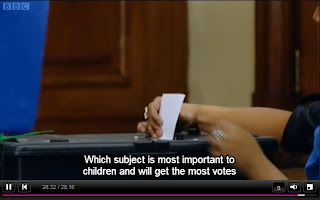
A vote is cast into the ballot box

Andrew Neil counts votes in the 'first ever' CBBC election
Angellica asked: Which subject is most important to children and will get the most votes in our first ever CBBC election?
But, as I showed in my last blog, it wasn't the 'first ever' CBBC election. In fact the BBC has been doing this sort of thing back as far as 1983. I have suggested to the BBC that Election: Your Vote breached editorial guidelines, and am waiting to hear what they have to say.
From the above it can be seen that, far from meriting immunity from anti-discrimination legislation, the BBC needs to be kept under constant scrutiny.
Readers of this blog, and others will know that the BBC is not a particularly trustworthy broadcaster. Quite apart from the competition irregularities on Blue Peter, I have shown that CBBC has
The latter impropriety was raised with BBC management at the highest levels, but without success. The BBC Trust was also aware of this, but on 9 May 2008 gave management their full support, stating that the Trust was "satisfied that the public can be justified in maintaining its confidence in its BBC."
My last blog was about an election programme on CBBC.


Angellica asked: Which subject is most important to children and will get the most votes in our first ever CBBC election?
But, as I showed in my last blog, it wasn't the 'first ever' CBBC election. In fact the BBC has been doing this sort of thing back as far as 1983. I have suggested to the BBC that Election: Your Vote breached editorial guidelines, and am waiting to hear what they have to say.
From the above it can be seen that, far from meriting immunity from anti-discrimination legislation, the BBC needs to be kept under constant scrutiny.
Tuesday, April 27, 2010
The BBC is the world's most trusted, it is in many ways the world's greatest broadcaster. But people have frighteningly high standards of all of us. They demand the best and particularly in an age of scrutiny, my view is we have to be very open, very honest, we have to confront our issues, but we have to live up to the standards of clarity and honesty which the public demand of us.
Not my words, but those of BBC Director-General, Mark Thompson.
If clarity and honesty are as important to the BBC as Mr Thompson claims, the Corporation let children down when it broadcast Election: Your Vote last Thursday at 4.35pm on BBC One. The CBBC programme, introduced by Angellica Bell, would have misled many viewers in important respects.
Angellica: On May 6th adults will vote in the general election. But today we've put children in charge of politics, and you want answers .... You've taken advice from top celebrities .... You've been grilling some of Britain's leading politicians .... and now you're getting to vote on the issues that are most important to you .... in the very first CBBC Election Your Vote
The programme was carefully crafted to propagandise that BBC Children's is helping to empower kids by giving them a say in politics in the run-up to the general election. It's likely, from listening to Angellica's introduction, that kids would believe this was the first time kids had ever been involved in a CBBC election programme. The reality is that the programme's audience did not have a vote of any kind.
One of the top issues for kids is the economic situation. Akhil was put in touch with Evan Davis from the BBC to be briefed about the economic meltdown. But, not surprisingly, Evan didn't tell Akhil that economics journalists, including himself, had failed disastrously to scrutinise politicians and bankers in the lead-up to the credit crunch and economic collapse. See this blog entry for more discussion. Other countries such as India were more circumspect, and didn't follow the Wall Street path of deregulation. What happened in Britain, America and many other countries wasn't an inevitability.
CBBC's Election: Your Vote didn't mention that the LibDem's Vince Cable had been warning for some time of the consequences of economic deregulation. Akhil asked Alan Johnson: Why should we pay for your [the older generation's economic] mistakes? But because of the way the programme was structured, the differences between the political parties (on the four issues discussed) were blurred.
There was a vote on which of the four issues was most important to kids "in our first ever CBBC election." The results were: Economy 53 votes - War in Afghanistan 41 votes - Crime 32 votes - Environment 14 votes.
The fact is that BBC children's used to give kids a much more real say in politics than it does today. And to imply otherwise was deceitful. The clip below from Children's TV On Trial shows the way things used to be done:-
As you can see in the video, during earlier general elections Newsround organised a parallel election for kids much more along the lines of the real election. And back then kids were able to support real parties and campaign on real issues in their school hustings. But as time has passed the BBC's regard for children seems to have diminished, and now kids are treated with disdain.
Here is the link to Newsround's current general election web coverage. Newsround Election '97 was a mock general election open to all primary and secondary school pupils, which took place in the week before the real thing. See the Newsround Election '97 webpages for more details. You'll see a link to the results of previous Newsround elections going back to 1983.
Not my words, but those of BBC Director-General, Mark Thompson.
If clarity and honesty are as important to the BBC as Mr Thompson claims, the Corporation let children down when it broadcast Election: Your Vote last Thursday at 4.35pm on BBC One. The CBBC programme, introduced by Angellica Bell, would have misled many viewers in important respects.
Angellica: On May 6th adults will vote in the general election. But today we've put children in charge of politics, and you want answers .... You've taken advice from top celebrities .... You've been grilling some of Britain's leading politicians .... and now you're getting to vote on the issues that are most important to you .... in the very first CBBC Election Your Vote
The programme was carefully crafted to propagandise that BBC Children's is helping to empower kids by giving them a say in politics in the run-up to the general election. It's likely, from listening to Angellica's introduction, that kids would believe this was the first time kids had ever been involved in a CBBC election programme. The reality is that the programme's audience did not have a vote of any kind.
One of the top issues for kids is the economic situation. Akhil was put in touch with Evan Davis from the BBC to be briefed about the economic meltdown. But, not surprisingly, Evan didn't tell Akhil that economics journalists, including himself, had failed disastrously to scrutinise politicians and bankers in the lead-up to the credit crunch and economic collapse. See this blog entry for more discussion. Other countries such as India were more circumspect, and didn't follow the Wall Street path of deregulation. What happened in Britain, America and many other countries wasn't an inevitability.
CBBC's Election: Your Vote didn't mention that the LibDem's Vince Cable had been warning for some time of the consequences of economic deregulation. Akhil asked Alan Johnson: Why should we pay for your [the older generation's economic] mistakes? But because of the way the programme was structured, the differences between the political parties (on the four issues discussed) were blurred.
There was a vote on which of the four issues was most important to kids "in our first ever CBBC election." The results were: Economy 53 votes - War in Afghanistan 41 votes - Crime 32 votes - Environment 14 votes.
The fact is that BBC children's used to give kids a much more real say in politics than it does today. And to imply otherwise was deceitful. The clip below from Children's TV On Trial shows the way things used to be done:-
As you can see in the video, during earlier general elections Newsround organised a parallel election for kids much more along the lines of the real election. And back then kids were able to support real parties and campaign on real issues in their school hustings. But as time has passed the BBC's regard for children seems to have diminished, and now kids are treated with disdain.
Here is the link to Newsround's current general election web coverage. Newsround Election '97 was a mock general election open to all primary and secondary school pupils, which took place in the week before the real thing. See the Newsround Election '97 webpages for more details. You'll see a link to the results of previous Newsround elections going back to 1983.
Sunday, April 25, 2010
We saw from my last blog how, according to Newsround, birds can look for a girlfriend or even be in love with petrol pumps and pedalos. Yet if they're a same-sex couple like the two albatross mums in New Zealand, Newsround's journalists don't characterise them as in love with each other.
The Government's guidance to schools on combatting homophobia Stand Up For Us (pdf) begins with a quote from Archbishop Desmond Tutu: ‘Everyone is an insider, there are no outsiders – whatever their beliefs, whatever their colour, gender or sexuality’
American culture, sport and politics are amongst the topics Newsround likes to cover. But there is a downside to American culture - and those stories don't make it on to Newsround. Like the school proms, where kids have been excluded for no other reason than wanting to partner with the 'wrong' person.
Cynthia Stewart said "All I want is to be able to be myself and go to my prom with the person I love, just like any other student wants to do." Eventually the school relented. But there have been others in similar situations.
Constance McMillen was banned from her school prom and sought advice and assistance from the American Civil Liberties Union. While at the ACLU she thanked her supporters -
Later on Itawamba County Agricultural High School appeared to have relented. But then, a few days later, Constance discovered she'd been tricked. The school and all her community had conspired to organise two proms - one for outsiders and one for insiders - and not told outsiders about the deception. This excellent blog explains the situation.
Last week Ricky Boleto reported for Newsround from Northern Ireland.
Reem Hasaballah was born in the Sudan. Reem and her family went to Northern Ireland four years ago as refugees from the war. But when she went to school in Belfast people were really bad towards her because she was black and they were white. It was like them telling her "you don't belong here - get out." Reem didn't just do nothing. She went to politicians and is campaigning to get racism stamped out. Reem wasn't happy being treated as an outsider - as she says "I'd just like to see everyone equal - that's the only thing."
The Government's guidance to schools on combatting homophobia Stand Up For Us (pdf) begins with a quote from Archbishop Desmond Tutu: ‘Everyone is an insider, there are no outsiders – whatever their beliefs, whatever their colour, gender or sexuality’
American culture, sport and politics are amongst the topics Newsround likes to cover. But there is a downside to American culture - and those stories don't make it on to Newsround. Like the school proms, where kids have been excluded for no other reason than wanting to partner with the 'wrong' person.
Cynthia Stewart said "All I want is to be able to be myself and go to my prom with the person I love, just like any other student wants to do." Eventually the school relented. But there have been others in similar situations.
Constance McMillen was banned from her school prom and sought advice and assistance from the American Civil Liberties Union. While at the ACLU she thanked her supporters -
Later on Itawamba County Agricultural High School appeared to have relented. But then, a few days later, Constance discovered she'd been tricked. The school and all her community had conspired to organise two proms - one for outsiders and one for insiders - and not told outsiders about the deception. This excellent blog explains the situation.
Last week Ricky Boleto reported for Newsround from Northern Ireland.
Reem Hasaballah was born in the Sudan. Reem and her family went to Northern Ireland four years ago as refugees from the war. But when she went to school in Belfast people were really bad towards her because she was black and they were white. It was like them telling her "you don't belong here - get out." Reem didn't just do nothing. She went to politicians and is campaigning to get racism stamped out. Reem wasn't happy being treated as an outsider - as she says "I'd just like to see everyone equal - that's the only thing."
Tuesday, April 20, 2010
It's not just humans that show their affection for each other on Valentine's Day - animals do it too! Not sure why animals would choose Valentine's day to show affection, but that's what it says on this Newsround webpage.
Newsround has carried some interesting love stories about our feathered friends in the past. There was the peacock who was head-over-heels in love with some petrol pumps. And then there was a swan who was besotted with a swan-shaped pedalo boat. Also a lovelorn albatross - he's spent ages trying to find "a girlfriend"
But Newsround has been less willing to report on same-sex affection. So, unless viewers check out newspapers, they might not know about the male swan couple in a Weymouth swannery. Even on the one occasion when Newsround did carry a story about a same-sex couple, just after the start of this year's LGBT History Month, the programme reported that the two female albatrosses "have paired up to care for the newborn after its dad left." Newsround took care to avoid any mention of affection or romance.
Newsround has carried some interesting love stories about our feathered friends in the past. There was the peacock who was head-over-heels in love with some petrol pumps. And then there was a swan who was besotted with a swan-shaped pedalo boat. Also a lovelorn albatross - he's spent ages trying to find "a girlfriend"
But Newsround has been less willing to report on same-sex affection. So, unless viewers check out newspapers, they might not know about the male swan couple in a Weymouth swannery. Even on the one occasion when Newsround did carry a story about a same-sex couple, just after the start of this year's LGBT History Month, the programme reported that the two female albatrosses "have paired up to care for the newborn after its dad left." Newsround took care to avoid any mention of affection or romance.
Monday, April 19, 2010
It's reported that Adrian Chiles is to leave the BBC. I contacted him last November, but unfortunately he never found the time to respond.
Email to Adrian
I haven't been in touch with you before, but I was impressed with your stance against racism when Carol Thatcher referred to Jo-Wilfried Tsonga as a "golliwog" earlier this year. I believe that the casual use of racist or homophobic language demeans the people or group concerned, thereby emboldening prejudice, and possibly leading to verbal or even violent abuse.
As you're aware, recently there have been a spate of homophobic attacks around Britain, building up over the last few months. I'm rather concerned about some of the language about gay people on TV - for example, use the word 'poof' by Jonathan Ross and some of his guests on a Friday night show on BBC One.
Please can you let me know how you feel about the issue, and whether you think it might be worth doing a report about it on The One Show?
I hope to hear back soon. Many thanks.
Email to Adrian
I haven't been in touch with you before, but I was impressed with your stance against racism when Carol Thatcher referred to Jo-Wilfried Tsonga as a "golliwog" earlier this year. I believe that the casual use of racist or homophobic language demeans the people or group concerned, thereby emboldening prejudice, and possibly leading to verbal or even violent abuse.
As you're aware, recently there have been a spate of homophobic attacks around Britain, building up over the last few months. I'm rather concerned about some of the language about gay people on TV - for example, use the word 'poof' by Jonathan Ross and some of his guests on a Friday night show on BBC One.
Please can you let me know how you feel about the issue, and whether you think it might be worth doing a report about it on The One Show?
I hope to hear back soon. Many thanks.
Saturday, April 17, 2010
What a pity that last night's Newsround from Cardiff missed the opportunity to give kids a real say, rather than, as last week, just a token three or four comments from school kids and a ballot on the stories to be included.
The main story was about two schools in Cardiff. One of the schools - Ysgol Gymraeg Treganna - teaches lessons in Welsh, and is oversubscribed and consequentially in need of more space. The other school - Lansdowne Primary School - teaches in English and, as one girl pointed out in Ricky's report, is diverse and teaches kids from a range of cultural backgrounds. However Lansdowne is facing possible closure to make way for the other school.
Ricky was presenting live from Cardiff Bay. And with him were ten kids from each of the schools. But instead of letting kids have an election-style debate on their school situation, and maybe having some impact on the outcome, Newsround seemed more intent on showing that the children were involved in choosing, to an extent, the news stories covered. This doesn't amount to a high level on Hart's Ladder of Participation (see previous blog)
Apparently, that morning producers in London had sent Ricky a selection of eight possible stories from which the kids had to pick three, via a ballot box. The options were:
1 Party leaders TV debate
2 Building made from bottles
3 World Cup tickets
4 Badger cull in Wales
5 Volcano cloud from Iceland
6 Surfing in Scotland
7 Meteor in Wisconsin
8 Daredevil pilot in Australia
The three stories chosen by ballot were the volcano in Iceland, the daredevil pilot in Australia, and the bottle building in Taiwan.
The girl who'd earlier talked about Lansdowne school's character told Ricky she hadn't especially wanted Newsround to cover the political leaders TV debate "because if children aren't allowed to vote, then what's the point watching it." Nevertheless it became clear that, no matter how the kids had voted, Newsround was determined to somehow cover that story. Sonali managed to sneak in something about the debate towards the end of the programme.
Sonali: .... make sure you head over to the special 'General Election' section - oh that rhymes - on the Newsround website. While you're there check out how many people tuned in to watch last night's historic TV battle between the three men who want to be Prime Minister. Almost ten million people! You've got to check out that story.
So Newsround made a big thing about consulting kids, even going so far as to hold a ballot, and then overrode their decision by putting in the story anyway.
There have been some significant changes in the times Newsround is broadcast. So the Newsround team ought to ensure that this webpage is updated to show the new times. Only the most avid viewers will have been aware of the changes coming this weekend.
The main story was about two schools in Cardiff. One of the schools - Ysgol Gymraeg Treganna - teaches lessons in Welsh, and is oversubscribed and consequentially in need of more space. The other school - Lansdowne Primary School - teaches in English and, as one girl pointed out in Ricky's report, is diverse and teaches kids from a range of cultural backgrounds. However Lansdowne is facing possible closure to make way for the other school.
Ricky was presenting live from Cardiff Bay. And with him were ten kids from each of the schools. But instead of letting kids have an election-style debate on their school situation, and maybe having some impact on the outcome, Newsround seemed more intent on showing that the children were involved in choosing, to an extent, the news stories covered. This doesn't amount to a high level on Hart's Ladder of Participation (see previous blog)
Apparently, that morning producers in London had sent Ricky a selection of eight possible stories from which the kids had to pick three, via a ballot box. The options were:
1 Party leaders TV debate
2 Building made from bottles
3 World Cup tickets
4 Badger cull in Wales
5 Volcano cloud from Iceland
6 Surfing in Scotland
7 Meteor in Wisconsin
8 Daredevil pilot in Australia
The three stories chosen by ballot were the volcano in Iceland, the daredevil pilot in Australia, and the bottle building in Taiwan.
The girl who'd earlier talked about Lansdowne school's character told Ricky she hadn't especially wanted Newsround to cover the political leaders TV debate "because if children aren't allowed to vote, then what's the point watching it." Nevertheless it became clear that, no matter how the kids had voted, Newsround was determined to somehow cover that story. Sonali managed to sneak in something about the debate towards the end of the programme.
Sonali: .... make sure you head over to the special 'General Election' section - oh that rhymes - on the Newsround website. While you're there check out how many people tuned in to watch last night's historic TV battle between the three men who want to be Prime Minister. Almost ten million people! You've got to check out that story.
So Newsround made a big thing about consulting kids, even going so far as to hold a ballot, and then overrode their decision by putting in the story anyway.
There have been some significant changes in the times Newsround is broadcast. So the Newsround team ought to ensure that this webpage is updated to show the new times. Only the most avid viewers will have been aware of the changes coming this weekend.
Tuesday, April 13, 2010
One thing from Friday's 'Have Your Say' edition of Newsround (see last blog) came across clearly - kids don't feel they're being taken seriously by politicians. As Anthony Horowitz put it in The Independent: It seems to me that the cynical politicians pay lip service to "kids". The smart ones will remember that that's where they began.
As an example, one of the key intentions of the Children, Schools and Families Bill was to put Personal, Social and Health Education (PSHE) on a statutory footing and ensure that all young people received at least one year of sex and relationship education. This has been one of the campaigns championed by the UK Youth Parliament.
But last week the measure was ditched in a stitch-up prompted by old-style politics.
Baroness Walmsley spoke about the betrayal of young people in the House of Lords.
 Baroness Walmsley: My Lords, I feel like the boy who stood on the burning deck when all around had fled. I and so many others have campaigned for so long to give children their right to life-saving and life-enhancing education by making PSHE a statutory subject in schools. Now our young people have been betrayed by the old alliance of old parties-the "Labservatives". The Government and the official Opposition have conspired behind closed doors to drop all the provisions that would have given children the high quality PSHE for which they have long asked, which they deserve and to which they have a right under the UN Convention on the Rights of the Child. It is the most truly shocking betrayal of my political life. ...
Kids don't just think it's the politicians who ignore them - it's adults too, as we saw in my previous blog:
After politicians ditched the SRE component of the Bill, a number of organisations including the UK Youth Parliament, Brook and the British Humanist Association signed a statement making clear that they would not give up the fight on behalf of young people in this country and their right to good, high quality sex and relationships education. Readers of this blog will not be surprised to learn that none of this was reported by Newsround, even though it's relevant and important to kids. Andy Hamflett signed on behalf of UK Youth Parliament.
Newsround has, however, given kids the chance to have their say about what they'd do if they were Prime Minister for a day. But, of course, their comments are subject to moderation by adults in the Newsround team.
Hart's Ladder of Participation
In my 25 March 2010 blog I referred to a document published by the Commonwealth Secretariat, which looks at the benefits and reasons for youth participation. In Chapter 6 we read: ...all too often, adults fail to respect the rights of children to express their views and they also fail to recognise that adolescents should have wider and deeper participation opportunities. Levels of participation have been summarised in the form of a ladder by a sociologist, Roger Hart.
Now look at how Ricky introduced Newsround last Friday. He said:
As an example, one of the key intentions of the Children, Schools and Families Bill was to put Personal, Social and Health Education (PSHE) on a statutory footing and ensure that all young people received at least one year of sex and relationship education. This has been one of the campaigns championed by the UK Youth Parliament.
But last week the measure was ditched in a stitch-up prompted by old-style politics.
Baroness Walmsley spoke about the betrayal of young people in the House of Lords.
 Baroness Walmsley: My Lords, I feel like the boy who stood on the burning deck when all around had fled. I and so many others have campaigned for so long to give children their right to life-saving and life-enhancing education by making PSHE a statutory subject in schools. Now our young people have been betrayed by the old alliance of old parties-the "Labservatives". The Government and the official Opposition have conspired behind closed doors to drop all the provisions that would have given children the high quality PSHE for which they have long asked, which they deserve and to which they have a right under the UN Convention on the Rights of the Child. It is the most truly shocking betrayal of my political life. ...
 Kids don't just think it's the politicians who ignore them - it's adults too, as we saw in my previous blog:
Ricky: And you (girl to Ricky's immediate right) want politicians to listen up, don't you?
Girl: And adults. Cos adults don't ... (Ricky interrupts, and moves mic away mid-sentence)
After politicians ditched the SRE component of the Bill, a number of organisations including the UK Youth Parliament, Brook and the British Humanist Association signed a statement making clear that they would not give up the fight on behalf of young people in this country and their right to good, high quality sex and relationships education. Readers of this blog will not be surprised to learn that none of this was reported by Newsround, even though it's relevant and important to kids. Andy Hamflett signed on behalf of UK Youth Parliament.
Newsround has, however, given kids the chance to have their say about what they'd do if they were Prime Minister for a day. But, of course, their comments are subject to moderation by adults in the Newsround team.
Hart's Ladder of Participation
In my 25 March 2010 blog I referred to a document published by the Commonwealth Secretariat, which looks at the benefits and reasons for youth participation. In Chapter 6 we read: ...all too often, adults fail to respect the rights of children to express their views and they also fail to recognise that adolescents should have wider and deeper participation opportunities. Levels of participation have been summarised in the form of a ladder by a sociologist, Roger Hart.
Now look at how Ricky introduced Newsround last Friday. He said:
Hello from Liverpool. We're live here on Newsround tonight for the first of our special 'Your Say' programmes. And the reason we're calling them 'Your Say' is because we're handing the programme over to you guys to decide what goes in it.More on this after the next Newsround General Election special programme from Cardiff.
Saturday, April 10, 2010
Newsround at 5pm last night. Ricky reporting live from Liverpool and Sonali in the London studio.
Ricky: Hello from Liverpool. We're live here on Newsround tonight for the first of our special 'Your Say' programmes. And the reason we're calling them 'Your Say' is because we're handing the programme over to you guys to decide what goes in it. It's all to do with the General Election. We're here at the start of our UK tour here in Liverpool, and the UK election will decide who will be our next Prime Minister.
Sonali: And I'm gonna be coming to you live from our studio in London, bringing you the stories that kids have chosen for today's show. Stay tuned to see what they've picked.
Ricky: Welcome guys. You happy to be here?
Kids: (after short pause) Yeah
 Ricky:
Zoe: Yeah - quite interesting.
Ricky: It was interesting. (moves mic to boy) What did you,, did you find it,, was it hard? Was it interesting? What did you think?
Kian: It was easy and hard at the same time.
Ricky: Kian, you were very good. Now these guys did a really good job. We'll find out more about the stories they chose a little bit later on. But first of all the top story is all about them. Take a look at this (video clip)
Ricky: Now before we head back to the studio for the rest of today's stories - (Turns to girl wearing pink dress) You did a really good job. Now do you think a lot of politicians don't take kids seriously? Do you still think that, and why?
Girl: Yeah I think they just push kids out of the way and think that we shouldn't be involved in anything like that.
Ricky: That's a good point. And you (girl to Ricky's immediate right) want politicians to listen up, don't you?
Girl: And adults. Cos adults don't ... (Ricky interrupts and moves mic away mid-sentence)
Ricky: Alright guys. Well thank you very much for your views. Sonali, back to you with the rest of their stories.
Sonali: Thank you very much Ricky, Kian, Grace, Maya and Zoe there. Now the second story they picked was about schools where you can call your teacher by their first name, get to wear comfy socks instead of school shoes and you go skiing for PE. Sounds brilliant doesn't it? Well Ore's been finding out all about them (video report on Finnish schools)
Sonali: That school looks brilliant. Now it looks like it's not going to be as easy to get away with downloading music without paying for it. A new law is about to be passed which could see internet users who get caught illegally downloading having their connection cut off. It's being brought in to protect the film and music industry which has lost millions of pounds because people download their stuff for free. But some reckon it's hard to tell who's actually doing it illegally.
Three more stories followed:-
1} Britain's tallest tree near Loch Fyne (64.24m high)
2} Clear-up has begun in Brazil after mudslides there killed 100's of people
3} Swarms of locusts have invaded a town in Australia
Sonali: So those were the stories that Kian and Zoe chose to go into the show today. Time to head back to the team in Liverpool. Hi there Ricky, where are you?
Ricky: Hey Sonali, welcome back. Well that was brilliant. Kian you did a good job with your cool school story. Were you happy to have that on TV?
Kian: Yeah
Ricky: Why did you like that story?
Kian: Because they were really relaxed and .. (Ricky takes the microphone away)
Ricky: Relaxed schools. Quite cool isn't it? Right, well our next stop in this General Election tour is in Cardiff in Wales. That's where we'll be heading next. Now I have a blog where you can check out all the latest behind-the-scenes information. Don't forget to tune into Newsround all weekend. See you soon. Bye bye.
Ricky: Hello from Liverpool. We're live here on Newsround tonight for the first of our special 'Your Say' programmes. And the reason we're calling them 'Your Say' is because we're handing the programme over to you guys to decide what goes in it. It's all to do with the General Election. We're here at the start of our UK tour here in Liverpool, and the UK election will decide who will be our next Prime Minister.
Sonali: And I'm gonna be coming to you live from our studio in London, bringing you the stories that kids have chosen for today's show. Stay tuned to see what they've picked.
Ricky: Welcome guys. You happy to be here?
Kids: (after short pause) Yeah
 Ricky:
 Yes! A bit more enthusiasm! Right. Over the next four weeks I'll be touring with Newsround to decide what will be going on in the General Election. We'll be telling you a lot about this over the next couple of weeks. And the General Election is happening in a month's time and that's when we decide who will be running our country.
Now our first stop is here in Liverpool which is famous for two football clubs. It's also famous for a few landmarks too, like the Liver Building and the beautiful River Mersey behind us. It's a beautiful day today isn't it? And besides the fact that we are outside, today there is another reason why this programme is very different. It's because these guys are getting to decide what goes on in our programme today.
And earlier today I met up with you two (girl and boy to Ricky's left) didn't I, and we went through what stories should be on Newsround today. (video clip shows the two kids, and another boy who was not on the live show) We had eight stories and we managed to boil that down to five. You decided what you did, and what you didn't want. Was it interesting to do that?
Zoe: Yeah - quite interesting.
Ricky: It was interesting. (moves mic to boy) What did you,, did you find it,, was it hard? Was it interesting? What did you think?
Kian: It was easy and hard at the same time.
Ricky: Kian, you were very good. Now these guys did a really good job. We'll find out more about the stories they chose a little bit later on. But first of all the top story is all about them. Take a look at this (video clip)
Ricky: Now before we head back to the studio for the rest of today's stories - (Turns to girl wearing pink dress) You did a really good job. Now do you think a lot of politicians don't take kids seriously? Do you still think that, and why?
Girl: Yeah I think they just push kids out of the way and think that we shouldn't be involved in anything like that.
Ricky: That's a good point. And you (girl to Ricky's immediate right) want politicians to listen up, don't you?
Girl: And adults. Cos adults don't ... (Ricky interrupts and moves mic away mid-sentence)
Ricky: Alright guys. Well thank you very much for your views. Sonali, back to you with the rest of their stories.
Sonali: Thank you very much Ricky, Kian, Grace, Maya and Zoe there. Now the second story they picked was about schools where you can call your teacher by their first name, get to wear comfy socks instead of school shoes and you go skiing for PE. Sounds brilliant doesn't it? Well Ore's been finding out all about them (video report on Finnish schools)
Sonali: That school looks brilliant. Now it looks like it's not going to be as easy to get away with downloading music without paying for it. A new law is about to be passed which could see internet users who get caught illegally downloading having their connection cut off. It's being brought in to protect the film and music industry which has lost millions of pounds because people download their stuff for free. But some reckon it's hard to tell who's actually doing it illegally.
Three more stories followed:-
1} Britain's tallest tree near Loch Fyne (64.24m high)
2} Clear-up has begun in Brazil after mudslides there killed 100's of people
3} Swarms of locusts have invaded a town in Australia
Sonali: So those were the stories that Kian and Zoe chose to go into the show today. Time to head back to the team in Liverpool. Hi there Ricky, where are you?
Ricky: Hey Sonali, welcome back. Well that was brilliant. Kian you did a good job with your cool school story. Were you happy to have that on TV?
Kian: Yeah
Ricky: Why did you like that story?
Kian: Because they were really relaxed and .. (Ricky takes the microphone away)
Ricky: Relaxed schools. Quite cool isn't it? Right, well our next stop in this General Election tour is in Cardiff in Wales. That's where we'll be heading next. Now I have a blog where you can check out all the latest behind-the-scenes information. Don't forget to tune into Newsround all weekend. See you soon. Bye bye.
Friday, April 09, 2010
In the run-up to the election Newsround has been asking kids to send in short clips saying what they'd do if they became prime minister. On Tuesday we heard from 11-year-old Brittany who has asthma and lives in a big block of flats. She'd done a press pack report about the poor living conditions in her area.
Brittany: ... I have asthma, and the cold concrete walls make it worse. I'm studying for my SATS at the moment, and I can't concentrate 'cos the noise from upstairs can be really bad. ..... The shouting from the stairwell can get really bad and keep me awake most of the night. My message for whomever wins the election is: Please, improve the housing of children.
Newsround is travelling to the four UK nations, and yesterday Ricky said he hopes to speak to some kids live from Liverpool on this evening's programme. Ricky on the Road
Brittany: ... I have asthma, and the cold concrete walls make it worse. I'm studying for my SATS at the moment, and I can't concentrate 'cos the noise from upstairs can be really bad. ..... The shouting from the stairwell can get really bad and keep me awake most of the night. My message for whomever wins the election is: Please, improve the housing of children.
Newsround is travelling to the four UK nations, and yesterday Ricky said he hopes to speak to some kids live from Liverpool on this evening's programme. Ricky on the Road
Thursday, April 08, 2010
Newsround is supposed to make things easier for kids to understand. So I wonder what they made of the sound of speed comment after this video report went out on this evening's 5pm edition.
Ore: Sounds incredible doesn't it? And Sonali, the organisers of the project say that he should break the sound of speed within 35 seconds of his descent. Doesn't that sound unbelievable?
Ore: Sounds incredible doesn't it? And Sonali, the organisers of the project say that he should break the sound of speed within 35 seconds of his descent. Doesn't that sound unbelievable?
Wednesday, April 07, 2010
In my blog on Sunday I referred to the fact that the Equality Bill ban on discrimination, victimisation and harassment will not apply in relation to broadcasting output. I suggested that the BBC uses the sacred cow of 'editorial independence' as a shield. At about 10.15pm last night Vera Baird, the Solicitor-General, spoke about the broadcasters' exemption.
Vera Baird: Let me turn briefly to broadcasting. Amendments 91 and 109 amend schedules 3 and 24, in response to broadcasters’ concerns, simply to make it clear that nothing in the Bill is intended to undermine their editorial independence. The amendments put it beyond doubt that the services and public functions provisions do not apply to broadcasting and distribution of content services.
Bill Cash asked: On the question of the editorial matters of the BBC, is the Minister satisfied that the rules regarding editorial policy embodied in the Charter and in the Guidelines adequately provide the degree of impartiality that is necessary in our present-day democracy? Does she think, perhaps, that the editorial policy needs to be tightened up?
Vera Baird: Let me turn briefly to broadcasting. Amendments 91 and 109 amend schedules 3 and 24, in response to broadcasters’ concerns, simply to make it clear that nothing in the Bill is intended to undermine their editorial independence. The amendments put it beyond doubt that the services and public functions provisions do not apply to broadcasting and distribution of content services.
Bill Cash asked: On the question of the editorial matters of the BBC, is the Minister satisfied that the rules regarding editorial policy embodied in the Charter and in the Guidelines adequately provide the degree of impartiality that is necessary in our present-day democracy? Does she think, perhaps, that the editorial policy needs to be tightened up?
Sunday, April 04, 2010
In view of Ben Bradshaw's remarks this morning about hypocrisy on the part of Conservatives, Newsround Blog readers may be interested in Mr Bradshaw's own behaviour. In May last year, Bradshaw was making allegations of homophobia, so I hope he won't accuse me too.
Bradshaw's department, the DCMS, has seemingly been complicit in making it easier for the BBC to discriminate. In an almost year-long Freedom of Information battle with the DCMS I'm attempting to find out what behind-the-scenes discussions have taken place between the DCMS and the broadcasters. Unfortunately the DCMS have delayed beyond accepted time limits at virtually every stage of my enquiries.
Last night, I emailed Mr Bradshaw that I was perplexed as to why the new Equality Bill will allow broadcasters to discriminate. I wrote: "The reason for my concern is that, in July last year, you told Pink News readers that you would look into BBC homophobia."
Despite evidence of BBC anti-gay discrimination, of which Bradshaw is aware, it has been agreed by politicians that the ban on discrimination, victimisation and harassment does not apply in relation to broadcasting output. The matter was briefly discussed in the House of Lords.
So the BBC will be able to use its sacred cow of 'editorial independence' / 'editorial judgement' as a shield. In fact the BBC will, as a result of the new Equality Act, be able to discriminate in areas which it is not allowed to at present. What makes things even worse is that the BBC could then, if it so wished, use the exemptions it enjoys under the Freedom of Information Act to avoid any public scrutiny of 'editorial' decisions.
Back to politicians, and following dismay about David Cameron's interview for Gay Times, Cameron told The Economist "When it’s actually come to issues of homosexual equality in the European Parliament, they’ve [Tory MEPs] actually always voted in favour of that." Strange that - you'd think his MEPs would then also support women's equality, but as I showed in my last blog that isn't the case.
Bradshaw's department, the DCMS, has seemingly been complicit in making it easier for the BBC to discriminate. In an almost year-long Freedom of Information battle with the DCMS I'm attempting to find out what behind-the-scenes discussions have taken place between the DCMS and the broadcasters. Unfortunately the DCMS have delayed beyond accepted time limits at virtually every stage of my enquiries.
Last night, I emailed Mr Bradshaw that I was perplexed as to why the new Equality Bill will allow broadcasters to discriminate. I wrote: "The reason for my concern is that, in July last year, you told Pink News readers that you would look into BBC homophobia."
Despite evidence of BBC anti-gay discrimination, of which Bradshaw is aware, it has been agreed by politicians that the ban on discrimination, victimisation and harassment does not apply in relation to broadcasting output. The matter was briefly discussed in the House of Lords.
So the BBC will be able to use its sacred cow of 'editorial independence' / 'editorial judgement' as a shield. In fact the BBC will, as a result of the new Equality Act, be able to discriminate in areas which it is not allowed to at present. What makes things even worse is that the BBC could then, if it so wished, use the exemptions it enjoys under the Freedom of Information Act to avoid any public scrutiny of 'editorial' decisions.
Back to politicians, and following dismay about David Cameron's interview for Gay Times, Cameron told The Economist "When it’s actually come to issues of homosexual equality in the European Parliament, they’ve [Tory MEPs] actually always voted in favour of that." Strange that - you'd think his MEPs would then also support women's equality, but as I showed in my last blog that isn't the case.
Friday, April 02, 2010
The leader of UKIP, Nigel Farage, was amongst the guests on last night's Have I Got News For You. The "missing words" round included a headline: "Show support for UKIP by .........!"
 Nigel Farage suggested the blanked out words were " not taking illegal immigrants, because there's just too many of them in this country and ...." After a bit more ranting Paul Merton told Farage it was supposed to fit the blanked out space.
It turned out the correct answer was "Show support for UKIP by cosying up in your dressing gown!" Seems that UKIP are marketing "KEEP THE POUND" dressing gowns.
 As part of the ensuing banter, host Lee Mack asked Farage: Do UKIP allow women to vote? Farage replied "We're terribly liberal and modern about that sort of thing, we really are."
This was an interesting response, because on 25 February 2010 there was a vote in the European Parliament calling for gender equality and the elimination of discrimination against women. Most of UKIP's MEPs voted against the motion, as did the two BNP MEPs and nearly all the Conservative MEPs. As result of the Conservative, UKIP and BNP votes, Britain had the unique and dubious distinction of being the only EU member state where more of our MEPs voted against full equality for women than voted in support of the resolution.
David Cameron was interviewed for Gay Times last month and at one point the interviewer, Martin Popplewell said to Mr Cameron, "You want us to vote for you. If we vote for you - we want you to vote for us." This interview was very widely reported in Britain, but not by the BBC. Nor was the detailed MEP voting after the European Parliament equality debate.
That is exactly the sort of information voters should know when they cast their votes at the next General Election. As a public service broadcaster encouraging community cohesion, the BBC should reflect all groups and report the news fairly and impartially.
Just as news manipulation on Newsround disempowers its young audience, so politician/journalist talking-point-driven news management is anathema to a more open, just and cohesive society.
 Nigel Farage suggested the blanked out words were " not taking illegal immigrants, because there's just too many of them in this country and ...." After a bit more ranting Paul Merton told Farage it was supposed to fit the blanked out space.
It turned out the correct answer was "Show support for UKIP by cosying up in your dressing gown!" Seems that UKIP are marketing "KEEP THE POUND" dressing gowns.
 As part of the ensuing banter, host Lee Mack asked Farage: Do UKIP allow women to vote? Farage replied "We're terribly liberal and modern about that sort of thing, we really are."
This was an interesting response, because on 25 February 2010 there was a vote in the European Parliament calling for gender equality and the elimination of discrimination against women. Most of UKIP's MEPs voted against the motion, as did the two BNP MEPs and nearly all the Conservative MEPs. As result of the Conservative, UKIP and BNP votes, Britain had the unique and dubious distinction of being the only EU member state where more of our MEPs voted against full equality for women than voted in support of the resolution.
David Cameron was interviewed for Gay Times last month and at one point the interviewer, Martin Popplewell said to Mr Cameron, "You want us to vote for you. If we vote for you - we want you to vote for us." This interview was very widely reported in Britain, but not by the BBC. Nor was the detailed MEP voting after the European Parliament equality debate.
That is exactly the sort of information voters should know when they cast their votes at the next General Election. As a public service broadcaster encouraging community cohesion, the BBC should reflect all groups and report the news fairly and impartially.
Just as news manipulation on Newsround disempowers its young audience, so politician/journalist talking-point-driven news management is anathema to a more open, just and cohesive society.
Subscribe to:
Posts (Atom)