Sunday, June 28, 2009

Expense claims

On Thursday 21 May 2009 Newsround told kids about some of the outrageous claims MPs were making.

Sonali: More news. And the row over politicians and money is still going on. This man spent more than £1,600 of our money on a floating duck island, like this one, for his garden pond.

Sonali presenting Newsround on 21st May 2009

Sonali: Lots of people are now so fed up with it all, that they want an election straight away so everyone can decide which politicians they want to keep and which ones they want to kick out.

Yes, Sonali really did stress that it was "our money." Newsround was mistaken because, like Frank Cook's charity expense claim mentioned in my last blog, this claim by Peter Viggers MP was rejected. None of "our money" was involved in that instance. But the same is not true of BBC management's unconscionable expenses. Perhaps Newsround should establish editorial integrity by putting a few pertinent questions to those senior managers, all of whom earn much, much more than MPs.

Senior mangers, whilst apparently concerned not to "short-change licence-fee payers," at the same time spend "our money" on flowers, partying and gifts. Is there any other word than hypocrisy? Where is Newsround's investigation?

Friday, June 26, 2009

The media, including the BBC, have been doing a good job holding politicians to account for their expense claims. Not surprisingly, BBC management saw which way the wind was blowing, and decided to reveal their own expenses before they were required to do so by the Information Commissioner.

One of those BBC expenses was for a £100 bouquet of flowers, given by Jana Bennett to Jonathan Ross. Ms Bennett thought it appropriate to use licence fee payers' money to buy her gift to Mr Ross ... reminded me of Frank Cook MP, who claimed back £5 for a donation he'd made to charity. There was one significant difference though - in the case of Frank Cook his claim was rejected, but in Jana Bennett's case the BBC paid out.

MPs are rushing to pay back all those outrageous expense claims. The question is when are BBC management going to pay back all their outrageous expense claims? At least Members of Parliament can be voted out of office if we don't think they've behaved properly.

Wednesday, June 24, 2009

Taste, Standards and the BBC

Following the furore last year over the behaviour of Jonathan Ross and Russell Brand, the BBC today issued its study - Taste, Standards and the BBC: Public attitudes to morality, values and behaviour in UK broadcasting

BBC Creative Director, Alan Yentob was interviewed this afternoon on the BBC News channel. Short excerpt -

John Sopel: If you think of the debate that took place .. twenty years ago in the era of say, Mary Whitehouse, it was all about swearing, it was all about nudity - when could you show these things. Has the debate sort of changed now - that it's not so much that, it's about the respect that you maybe show individuals, rather than kind of humiliation and things like that?

Alan Yentob: That's absolutely true. It's true. For instance, it's very interesting in this report that sexual behaviour or the presentation of sex on screen - nobody thinks it's a problem ......

The report makes clear, amongst other things, that BBC programmes must never condone or celebrate intimidation and humiliation for the purposes of entertainment. New guidance, it says, is needed to ensure that everyone involved in programme making for the BBC understands that malicious intrusion, intimidation and humiliation are unacceptable.

I'm doubtful whether this report will have any bearing on the way people and issues are treated. In May 2009 Jonathan Ross suggested, on Radio 2, that parents with a gay son ought to perhaps have their son adopted. I've written to Alan Yentob to ask him if, in his opinion, the report will help judge the acceptability or otherwise of Ross' remark.

Friday, June 19, 2009

Jonathan Ross, the bully (continued)

Some months ago Jay Hunt, Controller of BBC One, sacked Carol Thatcher from the One Show after Thatcher had referred to a black tennis player as a "golliwog." On 5 February 2009 Jay Hunt explained, in an interview on Radio 4's Today programme at 8.10am, why Carol had been sacked. This excerpt follows from Carol Thatcher's remark:

Interviewer: And they complained did they - Adrian Chiles, Jo Brand [and] the charity worker?

Jay Hunt: The conversation was overheard both by them and by other people in the green room at the time. And the next day it was raised as an inappropriate piece of behaviour with the executive producer of the [One] Show.

Interviewer: So somebody complained and said "I want something done about this" ?

Jay Hunt: People were hugely offended. Jo Brand was offended at the time, Adrian was offended at the time, and they decided to raise it with the executive producer and to make it completely clear that they did not think that was an appropriate way for somebody who was being employed by the BBC at the time to speak in what was effectively a public space.

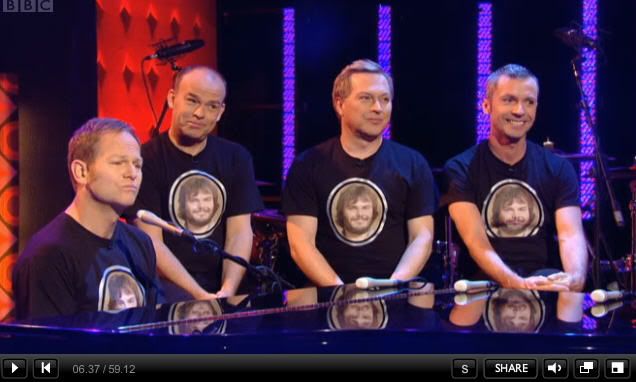
Knowing what Jay Hunt had to say about Carol Thatcher's remark, you might reasonably expect Ms Hunt to be concerned about offensive remarks made against gay people. But week after week Jonathan Ross pokes fun at his house band, and the BBC doesn't do anything about it. In fact Jay says that the house band "enjoy the weekly banter between themselves and Jonathan."

The weekly banter "between themselves and Jonathan" is one-way, with the band simply grinning or giggling in response. It's basically an employer/employee relationship, the abusive employer being Jonathan Ross and the BBC, and the employees being the members of his house band.

Secondly, it's doubtful that the band do actually enjoy Jonathan's digs at them. Doubts stem from a screen capture taken at the moment Jonathan finished saying the phrase ".. who wants a house band that spends most of its time sniffing your crotch and trying to hump your leg?" (see previous blog) At that instant some of the band members appear to be trying hard to put a brave face on the remark. This is the moment in question.

Monday, June 15, 2009

Jonathan Ross, the bully

Jonathan Ross is a bully. According to the BBC he is "not homophobic in any sense.." I disagree.

Let's look at the principal characteristics of a typical bully:-

He or she will pick on people who are less able to defend themselves.

He or she makes use of differences between people as the focus of insults

He or she believes that their behaviour makes them popular

He or she is a coward

Jonathan Ross has all of these attributes. Here's why:-

In May 2009 Jonathan Ross suggested, on his Radio 2 programme, that parents would not want a son to be gay and should get him adopted (see blog 17 May 2009). After the Radio 2 comment, and complaints to Ofcom, Ross said he was mortified that anyone would think he was being homophobic. Had that been a one-off remark about gay sexuality it would be possible to overlook it as a very unfortunate mistake. But the truth is that week after week Mr Ross insists on putting down the gay men in his house band. No other minority group gets such treatment on the BBC.

His house band may have chosen their name unwisely, but that does not entitle Jonathan Ross to demean them in the way he does. As one user of the Pink News' message board put it:-

If you are so mortified, Ross, then insist that those four gay men who sing on your program every week are called, by you at least, by some other name than "Four Poofs" . . . so that you will no longer be able to begin your weekly show with a show that implies gay men are focussed solely on having sex with each other and others.

Ross fosters the impression that such behavior is the norm and reasonable, and of course the band members always giggle at his joke. But has Ross considered how many gay people are subjected to similar treatment at school and at work. No doubt most people in similar situations will also laugh off the remarks, but inside they may be deeply hurt, and powerless to do anything about it.

Bullies like to choose vulnerable targets - and that's exactly what Ross does, with full backing from BBC management. The rapturous welcome he gets each week reassures him that he's cool and got loads of friends - bullies always like to think they're popular. Finally, Ross is a coward. He knows that if he were subjected to reasonable scrutiny he would have to drop the homophobia. But he will carry on as long as he's able, because at heart he's a bully, and a homophobic one at that.

This is what he said on last Friday's programme:-

Ross: ... I'm very pleased to announce some special news in my house. My dog, Mr Pickle - the apple of my eye - he has received a job offer. He has been invited, by a lady called Janet, to join a new musical group she's forming called 4 Pugs and a Piano. But as you can see it's not working at the moment because at the moment they've only got three. They've got three adorable pugs there - that's Ernie, Stanley and Dudley, OK. I already know their names - it took me years to remember that lot over there [Ross points to the members of his own house band]. Which is great news for Mr Pickle, not such good news necessarily for my current house band, because you know it's a difficult choice. Do I stick with them ... do I go with the pugs? Though of course who wants a house band that spends most of its time sniffing your crotch and trying to hump your leg? [to his band] Which is why I might have to replace you with the pugs. Don't tell me ... don't tell me you didn't see that coming.

House band and 3 pugs
Screen shot of Friday's programme

Saturday, June 13, 2009

The BBC is supposed to inform, educate and entertain. Children's programmes used to do those three things as was clear from the enlightening BBC Four series Children's TV on Trial (see blog on 9 April 2008) However, a once vibrant department has, with a few exceptions, been reduced to a wasteland of mediocrity. Whilst the BBC Trust has been candid in presenting the stark figures of declining audiences, nevertheless it has avoided the wood for the trees - i.e. it has largely failed to investigate whether programme content might have a significant bearing on the decline in reach.

The Trust say:- In terms of delivering the public purposes, we are concerned at the apparent decline in usage of BBC News by young people. We also continue to believe that the BBC could do more to provide output that is original and different and shows fresh and new ideas .... (p.25) It fails to draw the appropriate conclusions from the huge discrepancy in audience reach between CBBC and BBC Switch.

An example, taken from the 1980's Children's TV on Trial, shows that programmes used to be relevant to the needs of kids. Check how the BBC kept in touch with its young audience:-

Narrator: ... television's first agony uncle, Phillip Hodson talked viewers through the serious business of growing up.

(archive film clip) Phillip Hodson: You are still at primary school. You've already finished your puberty. You're only 10, and you've finished. (reads letter) I'm tall and broadly built, but I have to wear a bra.

Narrator: But it wasn't all about hormones and heartache. Uncle Phillip tackled some of the thornier issues of the day.

(archive film clip) Phillip Hodson: Because AIDS is a disease that can kill, because we're afraid of diseases that can kill, and because there's no cure for AIDS - so what happens is that rumours fly and there's more ignorance about AIDS than almost anything else.

And the same programme showed how drama dealt with issues of the day:-

Lee Macdonald (actor from Grange Hill): The issues that were tackled with Grange Hill would be within normal schools anyway - especially comprehensives schools that I was brought up in. You've got bullying, your shoplifting, there was pregnancies within school kids. And I think that was where the stories were so strong and they were taken so seriously....

Steve Woodcock (actor from Grange Hill): We had things like the National Front that you had to contend with, and you'd be going to school with children whose parents were members of the National Front. So yes, Grange Hill was, I think, very true to what was going on at the time ....

What with the recent election successes of the BNP, perhaps it's time for kids' TV programmes to again be honest and forthright. The BNP should be identified as a racist organisation, and therefore beyond the pale. Newsround failed to do this in Adam's report last Monday (see blog 8 June 2009)

Wednesday, June 10, 2009

BBC Trust Review of services for younger audiences

At last the BBC Trust has had the courage to face up to the truth, at least in part. For example they recognise that BBC Switch on TV has not been very successful, and also that teenagers deserve better news services. Little is said about drama for young teens, although the Trust do acknowledge "that it is important for the BBC to provide older children and teenagers with some targeted output on television."

The Trust Review, published today, includes the following:

The BBC delivers some of its public purposes well to young people but faces challenges to deliver news to them, and to serve teenagers on television. BBC Switch "has not yet reached many teenagers on television. We continue to think that it is important for the BBC to provide older children and teenagers with some targeted output on television."

The Trust regard BBC News’ reach to young people as a very important performance indicator. A decline in the numbers of teenagers watching BBC television has driven an overall fall in BBC reach amongst teenagers. In response to its decline in reach to teenagers, the BBC launched BBC Switch but teenagers’ viewing of Switch on television is still low.

The Trust recognise that BBC Switch is "still an emerging proposition," but their view is that "its performance to date has been variable, with its television programmes in particular not yet reaching high enough volumes of the target audience." In fact the figure given by the Trust is 36,000 in the target age range 12 to 17 (0.8 per cent of the people in this age group)

Tuesday, June 09, 2009

Politicians aren't exactly flavour of the month, but there is a profession even more deserving of opprobrium. If journalists had been doing their jobs, the country might well be in a better position than it is. It's all very well for financial commentators like Evan Davis and Robert Peston to patiently explain the credit crunch, but we should have been warned years ago about the consequences of unbridled greed.

Greed is the cause of MPs' current plight, and it's also the root cause for the collapse in our economy. Goods are manufactured cheaply in countries where workers have few rights and little pay. All this helped to bring in bigger profits for shareholders, and so the 'economy' appeared to grow. Journalists should have warned us about the 'bonus culture,' but BBC management was party to this greed.

Good journalists are good for Britain. One of the best, who incidentally started his career on Newsround, is Krishnan Guru-Murthy. On Channel 4 News last night Krishnan asked a newly elected BNP Euro MP: Do you think that the impact of all immigrants and their descendants has been bad, or do you think that some of us are OK?

More on journalists and editorial independence shortly.

Monday, June 08, 2009

Yesterday this blog proved that the BBC is disingenuous regarding one of their six core values - We respect each other and celebrate our diversity so that everyone can give their best. I quoted part of an email from the BBC Trust in which it is clear that the BBC not only wish to be excused from a duty to promote equality, but they also want exemption from anti-discrimination legislation.

Newsround today included an item about elections to the European Parliament. During his report on the 5.05pm programme Adam said the following:

For the first time ever a group called the British National Party has won places in the European Parliament, and that's caused a huge fuss. They say they don't want any more people from abroad moving to Britain. They've been accused of being racist, but they say they're standing up for white British people.

Sunday, June 07, 2009

Diversity has been in the news recently, including in this report on Newsround's website. Diversity, however, is not just the group who won Britain's Got Talent last week. Quoted on the back of BBC staff identity cards, you'll find a set of six core values including: We respect each other and celebrate our diversity so that everyone can give their best.

In the first weeks of 2009 Newsround included reports about the first black President of the United States, a boy who has only two fingers and a thumb on each hand (7 January), Prince Harry's controversial remarks about race (12 Jan), difficulties for Travellers' families (22 Jan), Nintendo Wii used to help with physiotherapy for disabled kids (9 Feb), Paralympian gold medalist Ellie Simmonds received her MBE (18 Feb).

But in recent years there haven't been any reports at all about LGBT issues.

With the Government finding itself in such dire straits, it's clear that the new Equality Bill may not make any further progress. However one thing the proposals have achieved is to tease out the BBC's true position on diversity. The Corporation, as we've seen before, blatantly discriminates against some groups, including teenagers.

Now the BBC wants to ensure its discrimination is put on a formal basis, with an exemption to the proposed legislation. Or in the words of the BBC itself:

"... the commissioning, content and broadcasting of programmes and other output should be excluded from the positive duty to promote equality and also from the non-discrimination provisions."

So there you have it - what the BBC really thinks of diversity.

Friday, May 29, 2009

A month ago, Newsround ended with a story about a sweet shop in Southampton which had run a competition to invent a new flavour sweet (see blog on 28 April 2009). Yesterday's programme, at 5.05pm, ended with a similar item. This time it was a press pack report from 12 year old Harry, who told viewers that he had the best job in the world - a sweet taster.

Taking into account the problems of child obesity and considering the harmful effect of eating too many sweets, the editorial decision to include another item about confectionery, presented in an unfailingly positive light, is questionable to say the least. The BBC believes that its editorial independence is sacrosanct - a subject to which Newsround Blog will be returning in due course.

However Newsround began yesterday with a more constructive report presented by Ricky, which looked at the curious topic of glowing monkeys, and more generally at arguments for and against animal testing.

Thursday, May 21, 2009

That's it. You're up to date with all you need to know.

How many times have regular Newsround viewers heard the programme end with those, or similar words?

So what do kids need to know, and how well does Newsround fulfil its purpose of providing that information? Well, kids need to know the truth, presented honestly and fairly. And when mistakes are made, they should be acknowledged and corrected as soon as possible.

There were some interesting stories on Tuesday's programme at 5.05pm, but one item about a skydiver falling 6000 feet without a parachute included an unfortunate error: "... This is the story of the skydiver who fell 6000 feet - that's almost a mile ..." In fact 6000 feet is somewhat more than a mile, as you can easily see from this wolframalpha search.

A great pity the launch of WolframAlpha wasn't reported by Newsround over the weekend, as it is obviously something of which schoolkids should be aware. It's not on Newsround's website either.

Tuesday's programme began with an item about Miley Cyrus who, according to Newsround, was being bullied.

Sonali: Our top story today is bullying. It's a problem we talk about on Newsround quite often because it affects loads of you. But as Gavin's been finding out, people who you really wouldn't expect to get bullied do too - and guess what, they can find it just as upsetting and hurtful as the rest of us.

Gavin: ..... It all started when Miley made a jokey comment about her legs looking a bit jiggly on the social networking site Twitter. Then loads more people added comments about her weight. But Miley hit back, saying that she's just a normal girl and that making comments about people being fat are really dangerous. ....

The on-screen graphic quoted Miley Cyrus as saying "My legs are too jiggly" whereas the tweet was actually "i just jiggled my thighs and they shook on their own for 3 mississipis no more late night lucky charms." In other words her thighs shook for three seconds, and Miley felt she therefore needed to stop eating breakfast snacks at night.

A few hours later Miley responded to other people's remarks with:

"talk all you want. i have my flaws. im a normal girl theres things about my body i would change but stop with calling me f*t in post. i dont even like the word. those remarks that you hateful people use are fighting words. the ones that scar people and cause them to do damage to themselves or others. people that are so okay with being so hateful diguist me and need to spend last time on a gossip website and more time a. reading your bible b. reading stories/articles about what happens when cyber abuse and name calling happens. kids hurt themselves. this is not something to be taken lightly. i know these "message boards" are "no big deal" to YOU but is to the victim. this has got to stop!!! oh and ps if your thighs don't jiggle go see a doctor. thanks. :)"

Miley also posted a link to this webpage about cyberbullying.

Four comments from Newsround's feedback were read out at the end of the programme.

Sunday, May 17, 2009

International Day Against Homophobia 2009


Michael Causer

17th May every year is International Day Against Homophobia. A lot of people aren't sure exactly what homophobia is, so what better day than IDAHO to talk about it.

Broadly speaking homophobia is a type of prejudice related to people's sexual orientation. And, as with racism, it can range from thoughtless hurtful language to violence and even to murder. But with racism there is a zero tolerance attitude in society, which is still far from true with homophobia.

When gay teen Michael Causer was murdered the judge and jury at the subsequent trial refused to accept that homophobia was the motive, even though it was the only credible explanation for what happened. As a consequence of the judge and jury's own prejudice one of Michael's killers, Gavin Alker left court a free man. Yet according to witnesses, Alker had used language such as "watch yourself, he's a poof" and "you little queer faggot"

Michael's murder was one of several homophobic attacks and murders in Britain in the past year.

It's the casual homophobia, such as name-calling and bullying common in both primary and secondary schools, which facilitates a climate of prejudice in which these serious crimes take place. Recently Jonathan Ross made a remark on his Radio 2 programme. He's reported to have said "if your son asks for a Hannah Montana MP3 player, you might want to already think about putting him down for adoption before he brings his...erm...partner home." Ofcom received some complaints, as did the BBC.

On Thursday I asked the BBC Diversity Centre what advice they had given the BBC about the Ross incident, but they didn't have a bad word to say about him. The Diversity Centre told me "these off-the-cuff remarks were made purely in jest and were not intended to be offensive. Jonathan is not homophobic in any sense and never meant for his comments to be taken seriously."

Teens thrown out their homes for being gay, or students who can't get a loan from their parents to study at college, would not see the funny side of Jonathan's so-called 'jest' and what's more the Corporation can hardly describe the unceasing innuendo about gay men on his Friday night TV programme as 'off-the-cuff.' The introductions to Friday Night with Jonathan Ross are carefully scripted, and every week include an innuendo-laden gibe about gay men.

If, as Jonathan claims, he is mortified about accusations of homophobia, he could make amends by going much further than a tweet in support of Peter Tatchell. He should put an end to all the innuendo and stereotyping on his Friday night programme, and choose a house band based on reasons other than their willingness to be demeaned.

And yes, Jonathan Ross does know that his innuendo about gay men is unacceptable. That was clear when, on 22 February last year, he compared himself with comedian/pariah Jim Davidson (see blog on 31 October 2008)

Wednesday, May 13, 2009

The Equality Bill had its second reading on Monday and there were many good speeches explaining why equality is important. John Bercow pointed out that despite all the changes in legislation and, to a degree, in culture, children who are, or who are wrongly thought to be, lesbian, gay or bisexual are harassed and bullied on a monumental scale.

Lynne Featherstone said women in full-time work are paid 17% less than men, and 36% less if they work part-time. A disabled person is two and a half times more likely to be out of work. A person from an ethnic minority is 15.5% less able to find work. Sixty-two percent of over-50s believe they have been turned down for a job because of their age, and six in 10 lesbian or gay schoolchildren experience homophobic bullying.

Julie Morgan mentioned some initiatives in her constituency particularly the Skypad unit based at the University Hospital of Wales. It has special age-appropriate facilities for teenage cancer sufferers. The rooms are geared towards teenagers and there is a chill-out zone as well as computer games. That sort of development, said Ms Morgan, is exactly what we should be encouraging, because it is appropriate for the age of those young people. "They are not children, and they are not adults, but in the health service in general about two thirds of those who are at that in-between age are not in appropriate accommodation." Ms Morgan also talked about representations she had received from the Young Equals campaign (see previous blog)

Video about Skypad Unit

Sunday, May 10, 2009

Green shoots?

In its first few years of existence Newsround broke new ground and was prepared to be innovative. But in the last few years there's been a steady decline in Newsround's audience. The BBC Trust, in offering its views on children's services recently, attempted to put the blame on schedule changes and chose to ignore the likelihood that programme content and associated editorial decisions could be significant factors for the decline in interest. Complaints are continuing regarding the December 2008 message board deletions, and CBBC's unwillingness to take any notice of users.

The programme itself has become less willing to push forward the boundaries, precisely at a time when, with competing new media, BBC journalists need to be more prepared than ever to challenge and question. All too often Newsround is simply padded with the non-controversial and lazy option of sports news.

As a result Newsround has become boring and pretty much irrelevant to kids.

Despite a May 2007 promise to participate in Takeover Day, come November 2007 there was not a single mention of the event, not even coverage on Newsround's website. No coverage or participation in 2008 as well. And when last year a group of charities and young people launched the Young Equals campaign, including the Young Equals day of action on 28 August 2008, none of this was reported by Newsround.

Friday's Newsround programme, looked slightly more encouraging (Friday 8 May at 5.05pm)

Politics - row about MPs' expenses [1'48"]
Road safety [0'13"]
Neglected animals on a farm [0'13"]
Male primary school teachers [1'58"]
Miniatur Wunderland in Hamburg [1'44"]
Preview of Sportsround [0'20"]

The first news item was about why MPs are under fire for expense claims - a good story choice because it shows the need for journalistic scrutiny.

Sonali: First to a row about politicians being greedy. Over the past few months people have been getting more and more angry about the amount of our money being spent on their homes. And today we found out the surprising things they're spending the cash on.

Sonali's video report which followed included an interview with the BBC's top political journalist, Nick Robinson.

The next report on Friday was about kids' road safety in the UK. Sixteen countries have a better record, and the government needs to do more. Then came another short item, this time about the Gray family who had neglected animals on their farm in Buckinghamshire. The fourth item considered the dearth of male teachers in British primary schools (see blog on 26 April 2009). Yet even on this report Newsround couldn't quite manage to steer clear of gender stereotyping.

Sonali: When Newsround asked you what job you'd like to do when you're older, becoming a teacher was the top choice for girls. But for boys it was way down list and it seems the same story in primary school classrooms around the country. Gavin's been finding out more.

Friday's NR showed signs of being a bit more willing to question the existing order of things. It showed that sometimes adults make mistakes or do things because of their own selfish interests. Ultimately though, if CBBC want to increase its audiences it needs to more frequently challenge viewers and make programmes more relevant. Are we seeing the green shoots of a renaissance? If so, there are a few things Newsround might want to look at.

Young Equals is unhappy that new equality proposals, to be debated tomorrow, don't go further to stop discrimination against children. Why not report what the four children's commissioners, children's rights groups and individual kids are doing to help promote equality and fairness? Earlier this year the commissioners gave evidence to the joint parliamentary committee on human rights, but regrettably nothing on Newsround. And what about those CBBC message boards? The criticism continues, and still not a whisper from Newsround. The UK Youth Parliament is due, this summer, to have a plenary session in the House of Commons but up till now Newsround has demonstrated that it doesn't do youth democracy.

CBBC needs to get out of the rut of management's rigid target ages, which were endorsed uncritically by the BBC's supine sovereign body.

Wednesday, May 06, 2009

Chas Newkey-Burden, co-author of 'Not In My Name: A Compendium Of Modern Hypocrisy' writing in the 25th birthday edition of GT magazine (page 122) argues that there's a lot of imaginary homophobia about in Britain. In his opinion gay people are disproportionately visible in popular culture, and have "never had it so good."

He believes that we look for homophobia where there isn't any. As an example Newkey-Burden refers an elderly couple who own a hotel in Cornwall and are being accused of discrimination. He then goes on to criticise an article in a previous edition of GT magazine, in which the BBC was "astonishingly accused of being a “bastion” of homophobia." (see blog 11 March 2009) Chas says that one of the key pieces of evidence "for this jaw-dropping allegation" was remarks made about Lindsay Lohan which, he believes, are no different in kind to the "harmless banter" commonly heard in the gay community.

Newkey-Burden then goes on to contrast this with what he regards as serious cases of homophobia - people who are tortured, imprisoned and executed in some Middle Eastern countries for their homosexuality.

His piece ends by stating that making accusations of homophobia against Brian McFadden or Boris Johnson is easy, because neither tends to bite back particularly hard. Opposing anti-gay brutality in the Middle East and elsewhere, he says, "might actually take some courage – a quality in increasingly short supply in British gay life."

I'm not sure what Chas Newkey-Burden is on about. Four years ago he himself criticised a joke on the BBC's Have I Got News For You. True - it would require a great deal of courage for someone living in say Iran or Saudi Arabia to oppose anti-gay brutality. But for people in Britain who rely on the media for their living it takes almost as much courage to criticise the BBC - and that's something that Peter Tatchell has in spades.

Saturday, May 02, 2009

Changes at Newsround, and the BBC attack on diversity

There have been a few changes at Newsround, but whether for the better or for the worse remains to be seen.

More generally, as regular readers already know, the BBC is far from being comfortable with the principles of equality and diversity, and now it seems Channel 4 is assisting in a regrettable attempt to be exempted from some duties in the new Equality Bill.

According to the Guardian, the broadcasters are suggesting that their editorial independence would be compromised. Newsround Blog has been investigating, and will keep you informed.

Friday, May 01, 2009

Bullying questions

An article about the taunts endured by Tom Daley at his school appeared in the Guardian on 18 April 2009. Tom's bullying got worse after he took part in the Olympics last year.

"It's gone on a long time," he says of the hounding that now resembles bullying, "but it reached a peak after the Olympics and has just stayed there. They've been taking the mick for ages, calling me 'Diver Boy', but they now spend most of their time throwing stuff at me. I thought it would calm down but it hasn't."

Two days after the Guardian article Newsround began a week of reports about its investigation into the lives of children. The fieldwork for the investigation took place in January 2009, and presumably involved considerable planning. One of the principal findings was that children were most afraid of being bullied. But for some reason Newsround failed to report Tom Daley's bullying until the following Friday, by which time it had become a big story in the 'red tops'. Originally Newsround chose to minimise the issue of bullying as it affects kids at school.

On Tuesday 21 April:-

Ore: You spend nearly a thousand hours every year at school. It plays a big part in your life, but 1 in 4 of you think there's too much pressure to do well in exams. Bullying is a problem too, and more than half of the kids we asked told us they're distracted by badly behaved children. What's more 1 in 10 of you said that teachers are sometimes bullied or even attacked in class. Maddy's been investigating.

Kids bullying their teachers is a recognised issue, and it was the the focus of Maddy's report. However a "massive investigation" called All About You might be expected to look into the bullying problem as it affects kids themselves.

And then on Thursday 23 April:-

Ore: We all get scared sometimes and many of you share the same worries. The most frightening place for most of you is being in the dark. 4 out of 10 of you told us that it's where you felt least safe. But 1 in 5 of you said you feel unsafe on the streets. When we asked you what you were most afraid of, most of you said bullying but next on the list was getting stabbed or shot. 1 in 8 of you said that was your biggest fear.

Gavin's report followed, and as with Maddy's there was no mention of children who were concerned about bullying. So why did Newsround play down the problem of bullying? And why did CBBC remove the 'Bullying' message board and other peer help boards in December 2008? And why was all Aaron's expert help about bullying and growing up issues taken away as well?

CBBC's editorial judgement looks questionable if you ask me.

Wednesday, April 29, 2009

Switch - the BBC's service for teens - broadcasts about two hours of TV programmes per week. Most of BBC Switch TV air time consists of programmes made in, or about North America. Last Saturday one of the offerings was a new documentary series called Teen America, available here on the iPlayer for a short while. Nineteen year old Louis Bhose (Flash Louis) presents the series, and he began by saying that he'd been spending far too much time living in his own little world.

Bhose: So I've decided to spread my wings and checkout what other teens my age are up to across America. This week I'm going to find out if the life of a devout Christian could be for me.

Louis then proceeded to hook up with a group of fundamentalist Christians at a weekend 'Acquire the Fire' convention in Richmond, Virginia. He seemed quite at home with the group's enthusiasm when they shouted "Yes, yes, yes we do, we love Jesus, how about you?" Inside the convention hall he met up with guides Mani and Charlotte. Bhose listened to Christian rock, a group prayer, and a tearful session which he said made him feel a little uneasy.

Bhose: It's very interesting. They've created Christianity for the MTV generation. This is it. This is the big screens, but then they're relating it back to Christianity. They've found the formula and people are getting caught up in the hysteria and in the moment, and crying almost for the sake of it.

Bhose said he was a bit confused by it all.

Next we saw the groups founder Ron Luce dish out advice, with a prayer which was repeated a phrase at a time by those at the convention.

Luce: Lord Jesus make a covenant with my eyes. I refuse to let Hollywood tell me what sex is really about.

Then Luce demonstrated their attitude to pornography and lust by having a computer monitor smashed to pieces with a baseball bat, to wild cheering and applause of onlookers including Bhose himself.

Bhose chatted to Charlotte about her all-girl 'abstinence' class. Bhose said that Charlotte seemed to truly believe that God would find the right one for her.

After discussing the commercial side to the operation and then a short chat with Ron Luce, the documentary concluded with Bhose chatting to guides Mani and Charlotte. "This weekend hasn't converted me to Christianity," he said, "but it's taught me a lot more respect for it, speaking to people like you two and seeing that you're not crazy." Louis asked them to keep him updated because he wanted to know how the journey goes. He ended by joining Mani and Charlotte in a group embrace.

I was a little concerned about that particular programme because it seemed to me that Louis too readily embraced a fundamentalist religious movement, failing to look at it with a sufficiently critical eye.

Tuesday, April 28, 2009

Commercial channels can't advertise unhealthy food and snacks during programmes watched by kids. But that doesn't mean BBC children's TV can't include news items about sweets and chocs. In fact Newsround covered three separate chocolate-related stories between Monday 2 March and Friday 6 March this year.

Today's programme at 5.05pm ended with a story about a sweet shop in Southampton. The shop called The Sugar Shack is a traditional sweet shop which opened in November last year. The owner, who incidentally has sold sweets online for about three years, came up with the idea of a local competition for kids to think up their own new sweets. Emily and her brother Adam were late entrants to the competition, but they invented the winning flavours. Ricky carried out a taste test himself and slightly preferred Emily's Banana Sherbet over Adam's Blueberry Explosion.

After the news story Ore asked those who thought they might have better ideas to head over to the website and let Newsround know.