Language and offence (part 1)
David Cameron must have been taken aback earlier this week after an interview on Absolute Radio made the national news. Mr Cameron had used the same word which, a year ago, got children's author Jacqueline Wilson into trouble. A letter, it seems, can make a world of difference.
Those were trivial examples, but language does have the power to cause deliberate offence, and presumably that was the intention of Jonathan Ross in a reply to someone on Twitter recently.
Friday, July 31, 2009


Wednesday, July 29, 2009
On 7 May 2009 Newsround's first item was a press pack report from Kelly, who wanted to warn children to stay away from tanning salons. The first story on Newsround at 5pm this evening was also about the danger of sunbeds.
Ore: We're always being told sunbeds are dangerous, but today scientists are saying they're even more harmful than we thought. They reckon young people who use them are more likely to get skin cancer than those who don't. So what exactly are the risks? Gavin's been finding out.
Gavin: On a sunny say it can seem like there's nothing better to do than head down to the beach and take in a few rays. But living here in the UK can make that pretty difficult. So some people head down to their local sunbed salons to top up their tan, but the trouble is that can be pretty dangerous to their bodies, and it isn't always obvious at first. The dangers of sunbeds have been talked about for years. In the past world health bosses thought using them could lead to cancer. But now they say it definitely raises the risk, and is as dangerous for you as smoking cigarettes.
Jessica Harris (Cancer Research UK): Sunbeds give out UV radiation which is the same kind of radiation that comes out the sun. And what that does - it goes into your skin and damages DNA inside your cells and can lead it to change, and in the future that damage could build up and develop into skin cancer.
Gavin: Not everyone agrees with the new research though. The Sunbed Association says there's no proven link between using salons sensibly and getting skin cancer.
In the last half-minute of his report, Gavin went on to say that tanning shops will be banned for under 18's in Scotland from December, and he said the Government will decide what to do for the rest of Britain pending more research.
Perhaps Gavin's report would have been improved by explaining that the Sunbed Association disagreement might be because it is a trade association, funded by the industry. The news was, after all, based on extensive scientific research. And science itself is about proof, not about profit.
Lastly there was the Sunbed Association's reference to using salons "sensibly" - a term which wasn't defined, although the camera zoomed in momentarily on a notice giving safety advice to patrons.
Ore: We're always being told sunbeds are dangerous, but today scientists are saying they're even more harmful than we thought. They reckon young people who use them are more likely to get skin cancer than those who don't. So what exactly are the risks? Gavin's been finding out.
Gavin: On a sunny say it can seem like there's nothing better to do than head down to the beach and take in a few rays. But living here in the UK can make that pretty difficult. So some people head down to their local sunbed salons to top up their tan, but the trouble is that can be pretty dangerous to their bodies, and it isn't always obvious at first. The dangers of sunbeds have been talked about for years. In the past world health bosses thought using them could lead to cancer. But now they say it definitely raises the risk, and is as dangerous for you as smoking cigarettes.
Jessica Harris (Cancer Research UK): Sunbeds give out UV radiation which is the same kind of radiation that comes out the sun. And what that does - it goes into your skin and damages DNA inside your cells and can lead it to change, and in the future that damage could build up and develop into skin cancer.
Gavin: Not everyone agrees with the new research though. The Sunbed Association says there's no proven link between using salons sensibly and getting skin cancer.
In the last half-minute of his report, Gavin went on to say that tanning shops will be banned for under 18's in Scotland from December, and he said the Government will decide what to do for the rest of Britain pending more research.
Perhaps Gavin's report would have been improved by explaining that the Sunbed Association disagreement might be because it is a trade association, funded by the industry. The news was, after all, based on extensive scientific research. And science itself is about proof, not about profit.
Lastly there was the Sunbed Association's reference to using salons "sensibly" - a term which wasn't defined, although the camera zoomed in momentarily on a notice giving safety advice to patrons.
Tuesday, July 28, 2009
Newsround missed an opportunity over the weekend. The UK Youth Parliament was meeting in Kent to discuss future plans for campaigns. The BBC was there, and its news channel carried reports on Saturday which can still be viewed on the UK Youth Parliament site. Hopefully this kind of item will be carried on Newsround in the future, but this will only happen if the BBC wakes up to the fact that kids hate being patronised. And that explains why CBBC audiences have declined so much in recent years.
Thursday, July 23, 2009
Chris Moyles and Jonathan Ross
Chris Moyles is Radio 1's most popular, and often most controversial DJ. So said the narrator at the start of Wednesday's Who Do You Think You Are? documentary on BBC One. Just before the introductory title sequence we saw Chris Moyles question the origins of his surname.
Moyles: I've always thought for years and years that "moyles" was Gaelic for "soldier." Now I said it one day in the pub, and somebody went "no that's not right, Gaelic for soldier is .. " whatever. So I'd like to know if Moyles does mean anything. 'Soldier' would be good - 'Flower arranger' not so cool.
Programmes like WDYTYA usually require hours of filming, which are then edited down into a final hour-long documentary. So why choose that particular clip to introduce Moyles? The soldier/flower arranger comparison says a lot about the mindset of Mr Moyles, and perhaps the ethos of the BBC as well.
Later into the programme Moyles found out that his name means "bald."
Moyles: Despite the fact that I'm named after a person with no hair, my great-grandfather, James Moyles, was a soldier, so I want to find out more about him and, you know, bring some respect back to the Moyles name.
It would seem that 'respect' is something to be desired. But time after time respect is the very attribute Moyles begrudges some groups of people, especially those he considers effeminate or gay. Chris Moyles, like Jonathan Ross may deny being homophobic, but their attitude when presenting on radio and TV proves otherwise. And so far both of these presenters enjoy the full backing of the BBC - a Corporation which hasn't yet even considered the meaning of homophobia or its implications.
How do I know this?
Well, in May 2009 the BBC stated that Jonathan is not homophobic "in any sense." I tried to find out what the BBC does take to be homophobic. How could they be so certain that Jonathan is not homophobic? Their Diversity Centre was unable to answer my question, and suggested I ask another department.
Chris Moyles is Radio 1's most popular, and often most controversial DJ. So said the narrator at the start of Wednesday's Who Do You Think You Are? documentary on BBC One. Just before the introductory title sequence we saw Chris Moyles question the origins of his surname.
Moyles: I've always thought for years and years that "moyles" was Gaelic for "soldier." Now I said it one day in the pub, and somebody went "no that's not right, Gaelic for soldier is .. " whatever. So I'd like to know if Moyles does mean anything. 'Soldier' would be good - 'Flower arranger' not so cool.
Programmes like WDYTYA usually require hours of filming, which are then edited down into a final hour-long documentary. So why choose that particular clip to introduce Moyles? The soldier/flower arranger comparison says a lot about the mindset of Mr Moyles, and perhaps the ethos of the BBC as well.
Later into the programme Moyles found out that his name means "bald."
Moyles: Despite the fact that I'm named after a person with no hair, my great-grandfather, James Moyles, was a soldier, so I want to find out more about him and, you know, bring some respect back to the Moyles name.
It would seem that 'respect' is something to be desired. But time after time respect is the very attribute Moyles begrudges some groups of people, especially those he considers effeminate or gay. Chris Moyles, like Jonathan Ross may deny being homophobic, but their attitude when presenting on radio and TV proves otherwise. And so far both of these presenters enjoy the full backing of the BBC - a Corporation which hasn't yet even considered the meaning of homophobia or its implications.
How do I know this?
Well, in May 2009 the BBC stated that Jonathan is not homophobic "in any sense." I tried to find out what the BBC does take to be homophobic. How could they be so certain that Jonathan is not homophobic? Their Diversity Centre was unable to answer my question, and suggested I ask another department.
Sunday, July 19, 2009
Dame Edna's Question
Jonathan Ross's house band, on Friday, was introduced with the stale "jokey banter" he churns out each week ...
Ross: Talking of romantic breaks, may I introduce the men who love being taken up the Grand Canal by a gondolier .. it is ..they love Venice don't you .. they love Venice - all that water and not a car in sight. It's my house band 4 Poofs and a Piano.
First guest last Friday was Dame Edna Everage, who asked if the name of Jonathan's house band could be homophobic.
Jonathan's reply: I don't think so - the fellas named themselves, of course. And er I would have thought probably not. You wouldn't say something that was disrespectful about yourself, would you?
Perhaps Mr Ross needs reminding of the incident last autumn, which resulted in his suspension for 12 weeks. He and Russell Brand had left rude and insulting messages on an answering machine belonging to Andrew Sachs. The messages related to Andrew's granddaughter, Georgina Baillie. And to jog Mr Ross's memory a bit further, here is a link to Georgina's performing group.
So yes, maybe you might just call yourself something disrespectful in order to further your career. Being disrespectful can, however, lead to unfortunate consequences.
Jonathan Ross's house band, on Friday, was introduced with the stale "jokey banter" he churns out each week ...
Ross: Talking of romantic breaks, may I introduce the men who love being taken up the Grand Canal by a gondolier .. it is ..they love Venice don't you .. they love Venice - all that water and not a car in sight. It's my house band 4 Poofs and a Piano.
First guest last Friday was Dame Edna Everage, who asked if the name of Jonathan's house band could be homophobic.
Jonathan's reply: I don't think so - the fellas named themselves, of course. And er I would have thought probably not. You wouldn't say something that was disrespectful about yourself, would you?
Perhaps Mr Ross needs reminding of the incident last autumn, which resulted in his suspension for 12 weeks. He and Russell Brand had left rude and insulting messages on an answering machine belonging to Andrew Sachs. The messages related to Andrew's granddaughter, Georgina Baillie. And to jog Mr Ross's memory a bit further, here is a link to Georgina's performing group.
So yes, maybe you might just call yourself something disrespectful in order to further your career. Being disrespectful can, however, lead to unfortunate consequences.
Saturday, July 18, 2009
Yesterday was the first night of the Proms. But instead of celebrating this century-old British tradition, Newsround, once again, included an item about primary school proms.
Newsround's website says that thanks to films like High School Musical, American-style school proms are getting more and more popular. It seems that the BBC and BBC journalists are still oblivious to their own role in helping to ditch our indigenous culture. (see also blogs on 12 April 2008 and 22 July 2008)
Newsround's website says that thanks to films like High School Musical, American-style school proms are getting more and more popular. It seems that the BBC and BBC journalists are still oblivious to their own role in helping to ditch our indigenous culture. (see also blogs on 12 April 2008 and 22 July 2008)
Sunday, July 12, 2009
Ofcom ruling
Last week Ofcom published its ruling after it received complaints about a Radio 2 comment by Jonathan Ross. In May 2009 Jonathan had suggested parents with a gay son ought to perhaps get their son adopted. Mr Ross and the BBC have yet to apologise for the remark.
According to Ofcom's decision the 61 people who believed Jonathan's comment to be offensive and derogatory were mistaken. Ofcom concluded that the material was justified by the context, and met generally accepted standards.
The Equality and Human Rights Commission, however, says it works across the industry to ensure that broadcasters are mindful of the privileged position they hold and the importance of using the platform they have in a considerate way that takes account of the diversity of their audiences. In an emailed letter to me dated 2nd June 2009, written on behalf of Trevor Phillips, the Commission felt that the BBC should recognise the hurt that the kind of statement made by Mr Ross could cause to gay and lesbian people.
The EHRC statement about the "privileged position" of broadcasters was similar in sentiment to the words spoken by Jonathan Ross himself, on his return from a three month suspension (23rd Jan 2009)
.. being on the BBC and being allowed this level of freedom to communicate openly with people - it's a great privilege, and it's something I've always enjoyed and I value enormously. And in future I do intend to be more aware of the responsibility which comes with such a gift.
Out of interest I emailed Ed Richards of Ofcom last Monday, to ask if he had any comment to make about the contradictory positions of Ofcom and the EHRC in respect of Jonathan's Radio 2 remark.
Last week Ofcom published its ruling after it received complaints about a Radio 2 comment by Jonathan Ross. In May 2009 Jonathan had suggested parents with a gay son ought to perhaps get their son adopted. Mr Ross and the BBC have yet to apologise for the remark.
According to Ofcom's decision the 61 people who believed Jonathan's comment to be offensive and derogatory were mistaken. Ofcom concluded that the material was justified by the context, and met generally accepted standards.
The Equality and Human Rights Commission, however, says it works across the industry to ensure that broadcasters are mindful of the privileged position they hold and the importance of using the platform they have in a considerate way that takes account of the diversity of their audiences. In an emailed letter to me dated 2nd June 2009, written on behalf of Trevor Phillips, the Commission felt that the BBC should recognise the hurt that the kind of statement made by Mr Ross could cause to gay and lesbian people.
The EHRC statement about the "privileged position" of broadcasters was similar in sentiment to the words spoken by Jonathan Ross himself, on his return from a three month suspension (23rd Jan 2009)
.. being on the BBC and being allowed this level of freedom to communicate openly with people - it's a great privilege, and it's something I've always enjoyed and I value enormously. And in future I do intend to be more aware of the responsibility which comes with such a gift.
Out of interest I emailed Ed Richards of Ofcom last Monday, to ask if he had any comment to make about the contradictory positions of Ofcom and the EHRC in respect of Jonathan's Radio 2 remark.
Thursday, July 09, 2009
A broadcaster which claims to celebrate diversity might be expected to report the massive LGBT Pride event which took place in London at the weekend. But being the BBC the celebrations passed by without mention on its two national news programmes on Saturday night. Pride did get a mention as the fourth item on the BBC's London regional news programme at 6.20pm, but as we've come to expect Newsround completely ignored the diversity celebration.
In October last year the UN Committee on the Rights of the Child said it was concerned that children belonging to minority groups continue to experience discrimination and social stigmatization. The Committee noted the general climate of intolerance which appears to exist in the UK, including in the media, which may be the underlying cause of further infringements of kids' rights.
In that light, the UN Committee recommended (pdf file) that urgent measures were needed to address the intolerance. The Committee suggested awareness-raising and other preventive activities against discrimination and, if necessary, taking affirmative actions for the benefit of vulnerable groups of children.
Sunday's Newsround, in keeping with the UN Committee's recommendations, included a press pack report by Miriam, a Roma girl, who felt that if people understood her culture better it would help reduce the bullying problem (see blog 5 July 2009).
Newsround has unfortunately done nothing to tackle the problem of homophobic bullying - one of the few forms of bullying not even mentioned by the programme, and yet one of the most common forms of bullying.
An email from a young man in Ireland to the Irish minister of justice shows just how much distress can be caused by homophobic bullying. Declan's email is available on his blog and is quoted below:-
Dear Mr. Ahern,
I am aware at this stage that many people have emailed you about their problems with your recent plans for the forthcoming Civil Partnership Bill, you will have no doubt learned by now that lesbian and gay community are not happy with it. GLEN have said that we are happy to be getting this but we really aren't Minister! I don't know if you have children, but if you do could you imagine someone telling you that they aren't equal to their peers simply because they are gay!
I come from Abbeyfeale, a small town in West Limerick, growing up there was a complete nightmare for me. I was bullied for seven years and I don't mean school yard teasing and name calling, I was targeted because I was different, I was spat on, beaten up, threatened and it all started when I was 8yrs old. At the age of 16, crippled with depression I finally broke down in front of my family and I came out to them and I didn't expect the reaction I got - they have never treated me any differently than my other 5 brothers but I knew I could not stay in the town I grew up after I had decided to be open about my sexuality. I was being harassed in my workplace by grown-ups, I had stuff thrown at me from cars and again I was driven to the point of break.
These people treated me like I was the scum of the earth, all because I was gay! I could never fathom that, does it make sense when you think about it? Do you know how many times in my life I have been called a faggot? A queer? If it isn't ok to discriminate on the grounds of gender or race or religion, why is it ok for people to try and make my life hell on a regular basis! I went to college to better myself, I vote, I was paying my taxes up until I lost my job like thousands of other people - but simply because I am gay this seems to set me apart from 'normal' society!
Minister, your department stands for Justice! Why are you not standing up for the gay community? This Bill is a half-measure and as much good as you think you are doing let me tell you that you and your party are doing more harm to the gay community! By publishing this Bill you have said that we are not equal, that we are something below normal society! It must take a lot of hard work and a lot of intelligence to become to the Minister for Justice, could you please use some of that energy you have to try and fix this problem, please? What you are doing is not a good thing! Did you see 12,000 people march through Dublin City, on Saturday? 12,000 voices are telling you that this Bill does not go far enough and you need to listen.
If all you do is read this e-mail then you have managed to listen to just one voice but so many more are calling out to you. Minister I am tired of running away from bullies, I am tired of being treated like I am a second class citizen in a country that I love so much. So I have decided that I am not going to be bullied this time, I am going to stand up and I am going to fight back because if my parents have ever taught me anything it is that if you have something you believe in and deep in your heart you know is right then you have to fight for it. If it takes climbing onto the walls of the Dáil another 100times, marching down the streets of Dublin, Limerick, Cork and Galway, writing letters and e-mails, signing petitions and spreading the word about this inequality then you can be sure I will be doing my part.
I do not know if you will reply to this e-mail but please don't just disregard what I have said,
Regards,
Declan Doody
Later Declan's mother, Helen Doody, also wrote to the Irish justice minister, and her email is widely available on the internet including at this link on Pink News.
In October last year the UN Committee on the Rights of the Child said it was concerned that children belonging to minority groups continue to experience discrimination and social stigmatization. The Committee noted the general climate of intolerance which appears to exist in the UK, including in the media, which may be the underlying cause of further infringements of kids' rights.
In that light, the UN Committee recommended (pdf file) that urgent measures were needed to address the intolerance. The Committee suggested awareness-raising and other preventive activities against discrimination and, if necessary, taking affirmative actions for the benefit of vulnerable groups of children.
Sunday's Newsround, in keeping with the UN Committee's recommendations, included a press pack report by Miriam, a Roma girl, who felt that if people understood her culture better it would help reduce the bullying problem (see blog 5 July 2009).
Newsround has unfortunately done nothing to tackle the problem of homophobic bullying - one of the few forms of bullying not even mentioned by the programme, and yet one of the most common forms of bullying.
An email from a young man in Ireland to the Irish minister of justice shows just how much distress can be caused by homophobic bullying. Declan's email is available on his blog and is quoted below:-
Dear Mr. Ahern,
I am aware at this stage that many people have emailed you about their problems with your recent plans for the forthcoming Civil Partnership Bill, you will have no doubt learned by now that lesbian and gay community are not happy with it. GLEN have said that we are happy to be getting this but we really aren't Minister! I don't know if you have children, but if you do could you imagine someone telling you that they aren't equal to their peers simply because they are gay!
I come from Abbeyfeale, a small town in West Limerick, growing up there was a complete nightmare for me. I was bullied for seven years and I don't mean school yard teasing and name calling, I was targeted because I was different, I was spat on, beaten up, threatened and it all started when I was 8yrs old. At the age of 16, crippled with depression I finally broke down in front of my family and I came out to them and I didn't expect the reaction I got - they have never treated me any differently than my other 5 brothers but I knew I could not stay in the town I grew up after I had decided to be open about my sexuality. I was being harassed in my workplace by grown-ups, I had stuff thrown at me from cars and again I was driven to the point of break.
These people treated me like I was the scum of the earth, all because I was gay! I could never fathom that, does it make sense when you think about it? Do you know how many times in my life I have been called a faggot? A queer? If it isn't ok to discriminate on the grounds of gender or race or religion, why is it ok for people to try and make my life hell on a regular basis! I went to college to better myself, I vote, I was paying my taxes up until I lost my job like thousands of other people - but simply because I am gay this seems to set me apart from 'normal' society!
Minister, your department stands for Justice! Why are you not standing up for the gay community? This Bill is a half-measure and as much good as you think you are doing let me tell you that you and your party are doing more harm to the gay community! By publishing this Bill you have said that we are not equal, that we are something below normal society! It must take a lot of hard work and a lot of intelligence to become to the Minister for Justice, could you please use some of that energy you have to try and fix this problem, please? What you are doing is not a good thing! Did you see 12,000 people march through Dublin City, on Saturday? 12,000 voices are telling you that this Bill does not go far enough and you need to listen.
If all you do is read this e-mail then you have managed to listen to just one voice but so many more are calling out to you. Minister I am tired of running away from bullies, I am tired of being treated like I am a second class citizen in a country that I love so much. So I have decided that I am not going to be bullied this time, I am going to stand up and I am going to fight back because if my parents have ever taught me anything it is that if you have something you believe in and deep in your heart you know is right then you have to fight for it. If it takes climbing onto the walls of the Dáil another 100times, marching down the streets of Dublin, Limerick, Cork and Galway, writing letters and e-mails, signing petitions and spreading the word about this inequality then you can be sure I will be doing my part.
I do not know if you will reply to this e-mail but please don't just disregard what I have said,
Regards,
Declan Doody
Later Declan's mother, Helen Doody, also wrote to the Irish justice minister, and her email is widely available on the internet including at this link on Pink News.
Tuesday, July 07, 2009
BBC Director-general, Mark Thompson had nothing to say about homophobic banter when he was interviewed by Steve Hewlett recently (see blog on 1 July 2009). In the interview Mr Thompson said: The majority of the people, and here we're talking - depending on the question - of anything between 60% and 75% of the audience recognise that there's a trade-off. That if you want original new comedy, if you want cutting edge drama, it's inevitable, if the BBC's to give the creative space for people to do interesting, bold new work there is a risk that some people are gonna be offended.
So does the BBC class Jonathan Ross's "jokey banter" as original comedy? Is it perhaps interesting, bold new work? Of course it isn't. The scripted introductions to Friday Night with Jonathan Ross are of no more comedic value than the homophobic banter/bullying heard in Britain's worst workplaces every day.
In March 2009 it was "the men who are regularly taken up the Dolomites" and in May this year it was "the men who are never happier than when they're being taken up the Urals .." So how much has Jonathan's comedy actually progressed over time? Not much, it would seem, because a couple of years ago Jonathan's house band were "never happier than when they're being taken up the Orinoco."
Martina Navratilova was one of the guests on The Andrew Marr Show on Sunday. During the press review Martina commented on a Sunday Telegraph headline about Bishop Nazir Ali:- "Change and repent, bishop tells gays; Nazir-Ali reignites Church battle over homosexuality." Martina was very annoyed at the attitude of regarding lesbian and gay people only in terms of sex. "When you have a straight couple," Martina said "you don't automatically imagine Oh I wonder what they do behind closed doors."
In response Andrew Marr recalled Matthew Parris having said that equality will only be achieved when people are uninterested in a person's sexuality.
All-in-all, it seems clear that there is no reason whatsoever for Jonathan Ross's weekly homophobic banter. The BBC is doing a great disservice to the LGBT community, and the sooner the Corporation realises it the better.
So does the BBC class Jonathan Ross's "jokey banter" as original comedy? Is it perhaps interesting, bold new work? Of course it isn't. The scripted introductions to Friday Night with Jonathan Ross are of no more comedic value than the homophobic banter/bullying heard in Britain's worst workplaces every day.
In March 2009 it was "the men who are regularly taken up the Dolomites" and in May this year it was "the men who are never happier than when they're being taken up the Urals .." So how much has Jonathan's comedy actually progressed over time? Not much, it would seem, because a couple of years ago Jonathan's house band were "never happier than when they're being taken up the Orinoco."
Martina Navratilova was one of the guests on The Andrew Marr Show on Sunday. During the press review Martina commented on a Sunday Telegraph headline about Bishop Nazir Ali:- "Change and repent, bishop tells gays; Nazir-Ali reignites Church battle over homosexuality." Martina was very annoyed at the attitude of regarding lesbian and gay people only in terms of sex. "When you have a straight couple," Martina said "you don't automatically imagine Oh I wonder what they do behind closed doors."
In response Andrew Marr recalled Matthew Parris having said that equality will only be achieved when people are uninterested in a person's sexuality.
All-in-all, it seems clear that there is no reason whatsoever for Jonathan Ross's weekly homophobic banter. The BBC is doing a great disservice to the LGBT community, and the sooner the Corporation realises it the better.
Sunday, July 05, 2009
Last month, in Northern Ireland, several Roma families suffered racist attacks, and many felt the police there were slow in acting against the racist behaviour.
Today's Newsround included a press pack report by Miriam, an 11 year old Roma girl living in east London. Miriam is hoping to teach people more about Roma culture.
Ricky: .... Next up to the kids who are fed up of not being understood. You might not have heard of Roma people but they're sometimes referred to as "Gypsies," and face a few problems when growing up. Gavin's been to meet one girl, Miriam, who wanted to set the record straight.
Gavin: Meet 11 year old Miriam. Along with some of her mates she's taking on the job of telling people all about her life. Miriam is part of a group of people called the Roma community, who've settled all across Europe over the last 1000 years. In the UK there are loads of Roma kids who live and go to school here. But many of them feel they don't get treated as well as they deserve just because they're from another part of the world and have different traditions. She and her friends have taken to the streets, giving out picture books which they've helped to make, telling everyone their story. Here in east London there's a big community of Roma people and this event is designed to make the public more aware about their way of life. The kids here are giving out books and leaflets to teach people about their language, food and music. After the roadshow I went along to Miriam's house to hear just why she was so keen for people to know more about Roma.
Miriam: The best thing about Roma is that they always - whenever they go somewhere - they don't leave the culture, they always keep the culture - like the music, the stories, they never forget it. We speak differently, and .... Roma people .. you see them, you don't know who they are, and you see them on the streets and they still say "hello" to you even though they don't know you. They're like brothers and sisters. Some people know us by culture. They will hear a song and they will like it but then, if they find out that Roma people were playing it, they wouldn't like the song any more. I would like people in this country to know more about Roma people, so Roma people don't get bullied.
Gavin: So for Miriam and her family, the task of making people learn more about their culture and where they came from is only just beginning.
Today's Newsround included a press pack report by Miriam, an 11 year old Roma girl living in east London. Miriam is hoping to teach people more about Roma culture.
Ricky: .... Next up to the kids who are fed up of not being understood. You might not have heard of Roma people but they're sometimes referred to as "Gypsies," and face a few problems when growing up. Gavin's been to meet one girl, Miriam, who wanted to set the record straight.
Gavin: Meet 11 year old Miriam. Along with some of her mates she's taking on the job of telling people all about her life. Miriam is part of a group of people called the Roma community, who've settled all across Europe over the last 1000 years. In the UK there are loads of Roma kids who live and go to school here. But many of them feel they don't get treated as well as they deserve just because they're from another part of the world and have different traditions. She and her friends have taken to the streets, giving out picture books which they've helped to make, telling everyone their story. Here in east London there's a big community of Roma people and this event is designed to make the public more aware about their way of life. The kids here are giving out books and leaflets to teach people about their language, food and music. After the roadshow I went along to Miriam's house to hear just why she was so keen for people to know more about Roma.
Miriam: The best thing about Roma is that they always - whenever they go somewhere - they don't leave the culture, they always keep the culture - like the music, the stories, they never forget it. We speak differently, and .... Roma people .. you see them, you don't know who they are, and you see them on the streets and they still say "hello" to you even though they don't know you. They're like brothers and sisters. Some people know us by culture. They will hear a song and they will like it but then, if they find out that Roma people were playing it, they wouldn't like the song any more. I would like people in this country to know more about Roma people, so Roma people don't get bullied.
Gavin: So for Miriam and her family, the task of making people learn more about their culture and where they came from is only just beginning.
Wednesday, July 01, 2009
Last Wednesday Mark Thompson was interviewed by Steve Hewlett for The Media Show on Radio 4. Amongst the topics covered in the interview were Thompson's response to the recent Digital Britain proposals, and his strong defence of the reported £18 million paid to Jonathan Ross in a three year contract. Another item discussed was the "Taste, Standards and the BBC" report which was published that day, and was the subject of my blog on 24 June.
I've been in contact with the BBC to try and find out more about the corporation's understanding of "humiliation" in the light of this new study. Scant attention has been afforded in the report to matters of sexual orientation and homophobia. Nevertheless Steve Hewlett did put this to Mark Thompson, but the Director-general appeared unwilling to address the subject. Maybe Mark Thompson feared his anti-political-correctness credentials might suffer if he was ever heard to condemn homophobia.
Excerpt from the interview:-
Steve Hewlett: You've introduced a new guideline. This is new guidance on malicious intrusion, intimidation and humiliation - which I take it to be a pretty direct reference to some of the things that happened in the Ross/Brand case.
Mark Thompson: There were certainly things that happened on that programme which would fit in that rubric. But..
Steve Hewlett: But a lot of listeners would be mightily shocked that the BBC could possibly, under any circumstances, need a guideline to stop people behaving in ways, its own people behaving in ways, that were malicious, intrusive, intimidatory or humiliatory.
Mark Thompson: And to state the obvious, the overwhelming majority of BBC output doesn't include any material, and never has done.
Steve Hewlett: Then why do you need a guideline to stop them doing it?
Mark Thompson: Without making this part of the argument too circular, the Russell Brand Show, you know, emphasised to us that it was probably worth underlining this even more clearly.
Steve Hewlett: But doesn't it stand to reason that the people, the people responsible for authorising the broadcast of that programme didn't think that it was malicious, intrusive, intimidatory or humiliatory, otherwise they wouldn't have authorised the broadcast.
Mark Thompson: But behind that guidance we will absolutely continue to erm talk to, and work with our programme makers across the BBC to worry away at what that consists of.
Steve Hewlett: Do you think a guideline to that effect would stop Ross/Brand happening again?
Mark Thompson: I think that if we had had that guideline, and we'd backed it up, by thinking hard about how it might, might for example, you know relate to the use of practical joke phone calls and so forth, it might well have done. If we get, as it were, get that clear into all of our programme makers' head[s] - yes the chances of another Russell Brand happening would be much lower in the future.
Steve Hewlett: So is some of the stuff that one hears on Radio 1, with alarming or boring regularity depending upon your point of view - some of the homophobia and some of the Chris Moyles stuff he's been criticised for, and regulators have found against him for doing - is Radio 1 even vaguely consistent with this broader purpose? Or is that kind of material consistent with that broader purpose?
Mark Thompson: I'm saying that there are absolute boundaries. Now these are ..
Steve Hewlett: You've got a service which seems to be based on crossing them.
Mark Thompson: I don't believe that's the case. I mean the idea that jokey you know jokey banter and erm erm ...
Steve Hewlett: Homophobic banter?
Mark Thompson: Well no I mean the, the .. you know I'm afraid Steve, you know this is a world where you have to judge each programme on its merits, and you know when programmes overstep the mark, we need to try and make sure the programme makers understand that and stop them doing that in the future .....
I've been in contact with the BBC to try and find out more about the corporation's understanding of "humiliation" in the light of this new study. Scant attention has been afforded in the report to matters of sexual orientation and homophobia. Nevertheless Steve Hewlett did put this to Mark Thompson, but the Director-general appeared unwilling to address the subject. Maybe Mark Thompson feared his anti-political-correctness credentials might suffer if he was ever heard to condemn homophobia.
Excerpt from the interview:-
Steve Hewlett: You've introduced a new guideline. This is new guidance on malicious intrusion, intimidation and humiliation - which I take it to be a pretty direct reference to some of the things that happened in the Ross/Brand case.
Mark Thompson: There were certainly things that happened on that programme which would fit in that rubric. But..
Steve Hewlett: But a lot of listeners would be mightily shocked that the BBC could possibly, under any circumstances, need a guideline to stop people behaving in ways, its own people behaving in ways, that were malicious, intrusive, intimidatory or humiliatory.
Mark Thompson: And to state the obvious, the overwhelming majority of BBC output doesn't include any material, and never has done.
Steve Hewlett: Then why do you need a guideline to stop them doing it?
Mark Thompson: Without making this part of the argument too circular, the Russell Brand Show, you know, emphasised to us that it was probably worth underlining this even more clearly.
Steve Hewlett: But doesn't it stand to reason that the people, the people responsible for authorising the broadcast of that programme didn't think that it was malicious, intrusive, intimidatory or humiliatory, otherwise they wouldn't have authorised the broadcast.
Mark Thompson: But behind that guidance we will absolutely continue to erm talk to, and work with our programme makers across the BBC to worry away at what that consists of.
Steve Hewlett: Do you think a guideline to that effect would stop Ross/Brand happening again?
Mark Thompson: I think that if we had had that guideline, and we'd backed it up, by thinking hard about how it might, might for example, you know relate to the use of practical joke phone calls and so forth, it might well have done. If we get, as it were, get that clear into all of our programme makers' head[s] - yes the chances of another Russell Brand happening would be much lower in the future.
Steve Hewlett: So is some of the stuff that one hears on Radio 1, with alarming or boring regularity depending upon your point of view - some of the homophobia and some of the Chris Moyles stuff he's been criticised for, and regulators have found against him for doing - is Radio 1 even vaguely consistent with this broader purpose? Or is that kind of material consistent with that broader purpose?
Mark Thompson: I'm saying that there are absolute boundaries. Now these are ..
Steve Hewlett: You've got a service which seems to be based on crossing them.
Mark Thompson: I don't believe that's the case. I mean the idea that jokey you know jokey banter and erm erm ...
Steve Hewlett: Homophobic banter?
Mark Thompson: Well no I mean the, the .. you know I'm afraid Steve, you know this is a world where you have to judge each programme on its merits, and you know when programmes overstep the mark, we need to try and make sure the programme makers understand that and stop them doing that in the future .....
Sunday, June 28, 2009
Expense claims
On Thursday 21 May 2009 Newsround told kids about some of the outrageous claims MPs were making.
Sonali: More news. And the row over politicians and money is still going on. This man spent more than £1,600 of our money on a floating duck island, like this one, for his garden pond.

Sonali: Lots of people are now so fed up with it all, that they want an election straight away so everyone can decide which politicians they want to keep and which ones they want to kick out.
Yes, Sonali really did stress that it was "our money." Newsround was mistaken because, like Frank Cook's charity expense claim mentioned in my last blog, this claim by Peter Viggers MP was rejected. None of "our money" was involved in that instance. But the same is not true of BBC management's unconscionable expenses. Perhaps Newsround should establish editorial integrity by putting a few pertinent questions to those senior managers, all of whom earn much, much more than MPs.
Senior mangers, whilst apparently concerned not to "short-change licence-fee payers," at the same time spend "our money" on flowers, partying and gifts. Is there any other word than hypocrisy? Where is Newsround's investigation?
On Thursday 21 May 2009 Newsround told kids about some of the outrageous claims MPs were making.
Sonali: More news. And the row over politicians and money is still going on. This man spent more than £1,600 of our money on a floating duck island, like this one, for his garden pond.

Sonali: Lots of people are now so fed up with it all, that they want an election straight away so everyone can decide which politicians they want to keep and which ones they want to kick out.
Yes, Sonali really did stress that it was "our money." Newsround was mistaken because, like Frank Cook's charity expense claim mentioned in my last blog, this claim by Peter Viggers MP was rejected. None of "our money" was involved in that instance. But the same is not true of BBC management's unconscionable expenses. Perhaps Newsround should establish editorial integrity by putting a few pertinent questions to those senior managers, all of whom earn much, much more than MPs.
Senior mangers, whilst apparently concerned not to "short-change licence-fee payers," at the same time spend "our money" on flowers, partying and gifts. Is there any other word than hypocrisy? Where is Newsround's investigation?
Friday, June 26, 2009
The media, including the BBC, have been doing a good job holding politicians to account for their expense claims. Not surprisingly, BBC management saw which way the wind was blowing, and decided to reveal their own expenses before they were required to do so by the Information Commissioner.
One of those BBC expenses was for a £100 bouquet of flowers, given by Jana Bennett to Jonathan Ross. Ms Bennett thought it appropriate to use licence fee payers' money to buy her gift to Mr Ross ... reminded me of Frank Cook MP, who claimed back £5 for a donation he'd made to charity. There was one significant difference though - in the case of Frank Cook his claim was rejected, but in Jana Bennett's case the BBC paid out.
MPs are rushing to pay back all those outrageous expense claims. The question is when are BBC management going to pay back all their outrageous expense claims? At least Members of Parliament can be voted out of office if we don't think they've behaved properly.
One of those BBC expenses was for a £100 bouquet of flowers, given by Jana Bennett to Jonathan Ross. Ms Bennett thought it appropriate to use licence fee payers' money to buy her gift to Mr Ross ... reminded me of Frank Cook MP, who claimed back £5 for a donation he'd made to charity. There was one significant difference though - in the case of Frank Cook his claim was rejected, but in Jana Bennett's case the BBC paid out.
MPs are rushing to pay back all those outrageous expense claims. The question is when are BBC management going to pay back all their outrageous expense claims? At least Members of Parliament can be voted out of office if we don't think they've behaved properly.
Wednesday, June 24, 2009
Taste, Standards and the BBC
Following the furore last year over the behaviour of Jonathan Ross and Russell Brand, the BBC today issued its study - Taste, Standards and the BBC: Public attitudes to morality, values and behaviour in UK broadcasting
BBC Creative Director, Alan Yentob was interviewed this afternoon on the BBC News channel. Short excerpt -
John Sopel: If you think of the debate that took place .. twenty years ago in the era of say, Mary Whitehouse, it was all about swearing, it was all about nudity - when could you show these things. Has the debate sort of changed now - that it's not so much that, it's about the respect that you maybe show individuals, rather than kind of humiliation and things like that?
Alan Yentob: That's absolutely true. It's true. For instance, it's very interesting in this report that sexual behaviour or the presentation of sex on screen - nobody thinks it's a problem ......
The report makes clear, amongst other things, that BBC programmes must never condone or celebrate intimidation and humiliation for the purposes of entertainment. New guidance, it says, is needed to ensure that everyone involved in programme making for the BBC understands that malicious intrusion, intimidation and humiliation are unacceptable.
I'm doubtful whether this report will have any bearing on the way people and issues are treated. In May 2009 Jonathan Ross suggested, on Radio 2, that parents with a gay son ought to perhaps have their son adopted. I've written to Alan Yentob to ask him if, in his opinion, the report will help judge the acceptability or otherwise of Ross' remark.
Following the furore last year over the behaviour of Jonathan Ross and Russell Brand, the BBC today issued its study - Taste, Standards and the BBC: Public attitudes to morality, values and behaviour in UK broadcasting
BBC Creative Director, Alan Yentob was interviewed this afternoon on the BBC News channel. Short excerpt -
John Sopel: If you think of the debate that took place .. twenty years ago in the era of say, Mary Whitehouse, it was all about swearing, it was all about nudity - when could you show these things. Has the debate sort of changed now - that it's not so much that, it's about the respect that you maybe show individuals, rather than kind of humiliation and things like that?
Alan Yentob: That's absolutely true. It's true. For instance, it's very interesting in this report that sexual behaviour or the presentation of sex on screen - nobody thinks it's a problem ......
The report makes clear, amongst other things, that BBC programmes must never condone or celebrate intimidation and humiliation for the purposes of entertainment. New guidance, it says, is needed to ensure that everyone involved in programme making for the BBC understands that malicious intrusion, intimidation and humiliation are unacceptable.
I'm doubtful whether this report will have any bearing on the way people and issues are treated. In May 2009 Jonathan Ross suggested, on Radio 2, that parents with a gay son ought to perhaps have their son adopted. I've written to Alan Yentob to ask him if, in his opinion, the report will help judge the acceptability or otherwise of Ross' remark.
Friday, June 19, 2009
Jonathan Ross, the bully (continued)
Some months ago Jay Hunt, Controller of BBC One, sacked Carol Thatcher from the One Show after Thatcher had referred to a black tennis player as a "golliwog." On 5 February 2009 Jay Hunt explained, in an interview on Radio 4's Today programme at 8.10am, why Carol had been sacked. This excerpt follows from Carol Thatcher's remark:
Interviewer: And they complained did they - Adrian Chiles, Jo Brand [and] the charity worker?
Jay Hunt: The conversation was overheard both by them and by other people in the green room at the time. And the next day it was raised as an inappropriate piece of behaviour with the executive producer of the [One] Show.
Interviewer: So somebody complained and said "I want something done about this" ?
Jay Hunt: People were hugely offended. Jo Brand was offended at the time, Adrian was offended at the time, and they decided to raise it with the executive producer and to make it completely clear that they did not think that was an appropriate way for somebody who was being employed by the BBC at the time to speak in what was effectively a public space.
Knowing what Jay Hunt had to say about Carol Thatcher's remark, you might reasonably expect Ms Hunt to be concerned about offensive remarks made against gay people. But week after week Jonathan Ross pokes fun at his house band, and the BBC doesn't do anything about it. In fact Jay says that the house band "enjoy the weekly banter between themselves and Jonathan."
The weekly banter "between themselves and Jonathan" is one-way, with the band simply grinning or giggling in response. It's basically an employer/employee relationship, the abusive employer being Jonathan Ross and the BBC, and the employees being the members of his house band.
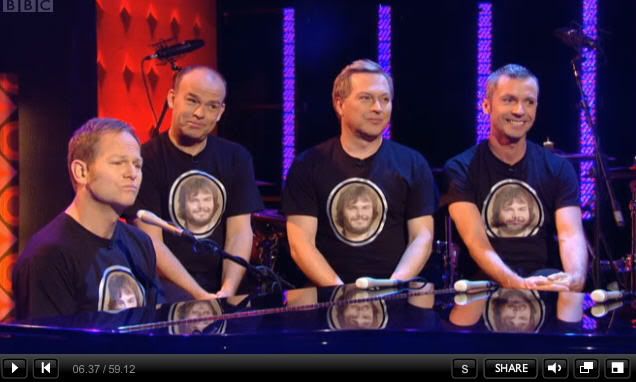
Secondly, it's doubtful that the band do actually enjoy Jonathan's digs at them. Doubts stem from a screen capture taken at the moment Jonathan finished saying the phrase ".. who wants a house band that spends most of its time sniffing your crotch and trying to hump your leg?" (see previous blog) At that instant some of the band members appear to be trying hard to put a brave face on the remark. This is the moment in question.
Some months ago Jay Hunt, Controller of BBC One, sacked Carol Thatcher from the One Show after Thatcher had referred to a black tennis player as a "golliwog." On 5 February 2009 Jay Hunt explained, in an interview on Radio 4's Today programme at 8.10am, why Carol had been sacked. This excerpt follows from Carol Thatcher's remark:
Interviewer: And they complained did they - Adrian Chiles, Jo Brand [and] the charity worker?
Jay Hunt: The conversation was overheard both by them and by other people in the green room at the time. And the next day it was raised as an inappropriate piece of behaviour with the executive producer of the [One] Show.
Interviewer: So somebody complained and said "I want something done about this" ?
Jay Hunt: People were hugely offended. Jo Brand was offended at the time, Adrian was offended at the time, and they decided to raise it with the executive producer and to make it completely clear that they did not think that was an appropriate way for somebody who was being employed by the BBC at the time to speak in what was effectively a public space.
Knowing what Jay Hunt had to say about Carol Thatcher's remark, you might reasonably expect Ms Hunt to be concerned about offensive remarks made against gay people. But week after week Jonathan Ross pokes fun at his house band, and the BBC doesn't do anything about it. In fact Jay says that the house band "enjoy the weekly banter between themselves and Jonathan."
The weekly banter "between themselves and Jonathan" is one-way, with the band simply grinning or giggling in response. It's basically an employer/employee relationship, the abusive employer being Jonathan Ross and the BBC, and the employees being the members of his house band.
Secondly, it's doubtful that the band do actually enjoy Jonathan's digs at them. Doubts stem from a screen capture taken at the moment Jonathan finished saying the phrase ".. who wants a house band that spends most of its time sniffing your crotch and trying to hump your leg?" (see previous blog) At that instant some of the band members appear to be trying hard to put a brave face on the remark. This is the moment in question.
Monday, June 15, 2009
Jonathan Ross, the bully
Jonathan Ross is a bully. According to the BBC he is "not homophobic in any sense.." I disagree.
Let's look at the principal characteristics of a typical bully:-
He or she will pick on people who are less able to defend themselves.
He or she makes use of differences between people as the focus of insults
He or she believes that their behaviour makes them popular
He or she is a coward
Jonathan Ross has all of these attributes. Here's why:-
In May 2009 Jonathan Ross suggested, on his Radio 2 programme, that parents would not want a son to be gay and should get him adopted (see blog 17 May 2009). After the Radio 2 comment, and complaints to Ofcom, Ross said he was mortified that anyone would think he was being homophobic. Had that been a one-off remark about gay sexuality it would be possible to overlook it as a very unfortunate mistake. But the truth is that week after week Mr Ross insists on putting down the gay men in his house band. No other minority group gets such treatment on the BBC.
His house band may have chosen their name unwisely, but that does not entitle Jonathan Ross to demean them in the way he does. As one user of the Pink News' message board put it:-
If you are so mortified, Ross, then insist that those four gay men who sing on your program every week are called, by you at least, by some other name than "Four Poofs" . . . so that you will no longer be able to begin your weekly show with a show that implies gay men are focussed solely on having sex with each other and others.
Ross fosters the impression that such behavior is the norm and reasonable, and of course the band members always giggle at his joke. But has Ross considered how many gay people are subjected to similar treatment at school and at work. No doubt most people in similar situations will also laugh off the remarks, but inside they may be deeply hurt, and powerless to do anything about it.
Bullies like to choose vulnerable targets - and that's exactly what Ross does, with full backing from BBC management. The rapturous welcome he gets each week reassures him that he's cool and got loads of friends - bullies always like to think they're popular. Finally, Ross is a coward. He knows that if he were subjected to reasonable scrutiny he would have to drop the homophobia. But he will carry on as long as he's able, because at heart he's a bully, and a homophobic one at that.
This is what he said on last Friday's programme:-
Ross: ... I'm very pleased to announce some special news in my house. My dog, Mr Pickle - the apple of my eye - he has received a job offer. He has been invited, by a lady called Janet, to join a new musical group she's forming called 4 Pugs and a Piano. But as you can see it's not working at the moment because at the moment they've only got three. They've got three adorable pugs there - that's Ernie, Stanley and Dudley, OK. I already know their names - it took me years to remember that lot over there [Ross points to the members of his own house band]. Which is great news for Mr Pickle, not such good news necessarily for my current house band, because you know it's a difficult choice. Do I stick with them ... do I go with the pugs? Though of course who wants a house band that spends most of its time sniffing your crotch and trying to hump your leg? [to his band] Which is why I might have to replace you with the pugs. Don't tell me ... don't tell me you didn't see that coming.

Screen shot of Friday's programme
Jonathan Ross is a bully. According to the BBC he is "not homophobic in any sense.." I disagree.
Let's look at the principal characteristics of a typical bully:-
He or she will pick on people who are less able to defend themselves.
He or she makes use of differences between people as the focus of insults
He or she believes that their behaviour makes them popular
He or she is a coward
Jonathan Ross has all of these attributes. Here's why:-
In May 2009 Jonathan Ross suggested, on his Radio 2 programme, that parents would not want a son to be gay and should get him adopted (see blog 17 May 2009). After the Radio 2 comment, and complaints to Ofcom, Ross said he was mortified that anyone would think he was being homophobic. Had that been a one-off remark about gay sexuality it would be possible to overlook it as a very unfortunate mistake. But the truth is that week after week Mr Ross insists on putting down the gay men in his house band. No other minority group gets such treatment on the BBC.
His house band may have chosen their name unwisely, but that does not entitle Jonathan Ross to demean them in the way he does. As one user of the Pink News' message board put it:-
If you are so mortified, Ross, then insist that those four gay men who sing on your program every week are called, by you at least, by some other name than "Four Poofs" . . . so that you will no longer be able to begin your weekly show with a show that implies gay men are focussed solely on having sex with each other and others.
Ross fosters the impression that such behavior is the norm and reasonable, and of course the band members always giggle at his joke. But has Ross considered how many gay people are subjected to similar treatment at school and at work. No doubt most people in similar situations will also laugh off the remarks, but inside they may be deeply hurt, and powerless to do anything about it.
Bullies like to choose vulnerable targets - and that's exactly what Ross does, with full backing from BBC management. The rapturous welcome he gets each week reassures him that he's cool and got loads of friends - bullies always like to think they're popular. Finally, Ross is a coward. He knows that if he were subjected to reasonable scrutiny he would have to drop the homophobia. But he will carry on as long as he's able, because at heart he's a bully, and a homophobic one at that.
This is what he said on last Friday's programme:-
Ross: ... I'm very pleased to announce some special news in my house. My dog, Mr Pickle - the apple of my eye - he has received a job offer. He has been invited, by a lady called Janet, to join a new musical group she's forming called 4 Pugs and a Piano. But as you can see it's not working at the moment because at the moment they've only got three. They've got three adorable pugs there - that's Ernie, Stanley and Dudley, OK. I already know their names - it took me years to remember that lot over there [Ross points to the members of his own house band]. Which is great news for Mr Pickle, not such good news necessarily for my current house band, because you know it's a difficult choice. Do I stick with them ... do I go with the pugs? Though of course who wants a house band that spends most of its time sniffing your crotch and trying to hump your leg? [to his band] Which is why I might have to replace you with the pugs. Don't tell me ... don't tell me you didn't see that coming.

Saturday, June 13, 2009
The BBC is supposed to inform, educate and entertain. Children's programmes used to do those three things as was clear from the enlightening BBC Four series Children's TV on Trial (see blog on 9 April 2008) However, a once vibrant department has, with a few exceptions, been reduced to a wasteland of mediocrity. Whilst the BBC Trust has been candid in presenting the stark figures of declining audiences, nevertheless it has avoided the wood for the trees - i.e. it has largely failed to investigate whether programme content might have a significant bearing on the decline in reach.
The Trust say:- In terms of delivering the public purposes, we are concerned at the apparent decline in usage of BBC News by young people. We also continue to believe that the BBC could do more to provide output that is original and different and shows fresh and new ideas .... (p.25) It fails to draw the appropriate conclusions from the huge discrepancy in audience reach between CBBC and BBC Switch.
An example, taken from the 1980's Children's TV on Trial, shows that programmes used to be relevant to the needs of kids. Check how the BBC kept in touch with its young audience:-
Narrator: ... television's first agony uncle, Phillip Hodson talked viewers through the serious business of growing up.
(archive film clip) Phillip Hodson: You are still at primary school. You've already finished your puberty. You're only 10, and you've finished. (reads letter) I'm tall and broadly built, but I have to wear a bra.
Narrator: But it wasn't all about hormones and heartache. Uncle Phillip tackled some of the thornier issues of the day.
(archive film clip) Phillip Hodson: Because AIDS is a disease that can kill, because we're afraid of diseases that can kill, and because there's no cure for AIDS - so what happens is that rumours fly and there's more ignorance about AIDS than almost anything else.
And the same programme showed how drama dealt with issues of the day:-
Lee Macdonald (actor from Grange Hill): The issues that were tackled with Grange Hill would be within normal schools anyway - especially comprehensives schools that I was brought up in. You've got bullying, your shoplifting, there was pregnancies within school kids. And I think that was where the stories were so strong and they were taken so seriously....
Steve Woodcock (actor from Grange Hill): We had things like the National Front that you had to contend with, and you'd be going to school with children whose parents were members of the National Front. So yes, Grange Hill was, I think, very true to what was going on at the time ....
What with the recent election successes of the BNP, perhaps it's time for kids' TV programmes to again be honest and forthright. The BNP should be identified as a racist organisation, and therefore beyond the pale. Newsround failed to do this in Adam's report last Monday (see blog 8 June 2009)
The Trust say:- In terms of delivering the public purposes, we are concerned at the apparent decline in usage of BBC News by young people. We also continue to believe that the BBC could do more to provide output that is original and different and shows fresh and new ideas .... (p.25) It fails to draw the appropriate conclusions from the huge discrepancy in audience reach between CBBC and BBC Switch.
An example, taken from the 1980's Children's TV on Trial, shows that programmes used to be relevant to the needs of kids. Check how the BBC kept in touch with its young audience:-
Narrator: ... television's first agony uncle, Phillip Hodson talked viewers through the serious business of growing up.
(archive film clip) Phillip Hodson: You are still at primary school. You've already finished your puberty. You're only 10, and you've finished. (reads letter) I'm tall and broadly built, but I have to wear a bra.
Narrator: But it wasn't all about hormones and heartache. Uncle Phillip tackled some of the thornier issues of the day.
(archive film clip) Phillip Hodson: Because AIDS is a disease that can kill, because we're afraid of diseases that can kill, and because there's no cure for AIDS - so what happens is that rumours fly and there's more ignorance about AIDS than almost anything else.
And the same programme showed how drama dealt with issues of the day:-
Lee Macdonald (actor from Grange Hill): The issues that were tackled with Grange Hill would be within normal schools anyway - especially comprehensives schools that I was brought up in. You've got bullying, your shoplifting, there was pregnancies within school kids. And I think that was where the stories were so strong and they were taken so seriously....
Steve Woodcock (actor from Grange Hill): We had things like the National Front that you had to contend with, and you'd be going to school with children whose parents were members of the National Front. So yes, Grange Hill was, I think, very true to what was going on at the time ....
What with the recent election successes of the BNP, perhaps it's time for kids' TV programmes to again be honest and forthright. The BNP should be identified as a racist organisation, and therefore beyond the pale. Newsround failed to do this in Adam's report last Monday (see blog 8 June 2009)
Wednesday, June 10, 2009
BBC Trust Review of services for younger audiences
At last the BBC Trust has had the courage to face up to the truth, at least in part. For example they recognise that BBC Switch on TV has not been very successful, and also that teenagers deserve better news services. Little is said about drama for young teens, although the Trust do acknowledge "that it is important for the BBC to provide older children and teenagers with some targeted output on television."
The Trust Review, published today, includes the following:
The BBC delivers some of its public purposes well to young people but faces challenges to deliver news to them, and to serve teenagers on television. BBC Switch "has not yet reached many teenagers on television. We continue to think that it is important for the BBC to provide older children and teenagers with some targeted output on television."
The Trust regard BBC News’ reach to young people as a very important performance indicator. A decline in the numbers of teenagers watching BBC television has driven an overall fall in BBC reach amongst teenagers. In response to its decline in reach to teenagers, the BBC launched BBC Switch but teenagers’ viewing of Switch on television is still low.
The Trust recognise that BBC Switch is "still an emerging proposition," but their view is that "its performance to date has been variable, with its television programmes in particular not yet reaching high enough volumes of the target audience." In fact the figure given by the Trust is 36,000 in the target age range 12 to 17 (0.8 per cent of the people in this age group)
At last the BBC Trust has had the courage to face up to the truth, at least in part. For example they recognise that BBC Switch on TV has not been very successful, and also that teenagers deserve better news services. Little is said about drama for young teens, although the Trust do acknowledge "that it is important for the BBC to provide older children and teenagers with some targeted output on television."
The Trust Review, published today, includes the following:
The BBC delivers some of its public purposes well to young people but faces challenges to deliver news to them, and to serve teenagers on television. BBC Switch "has not yet reached many teenagers on television. We continue to think that it is important for the BBC to provide older children and teenagers with some targeted output on television."
The Trust regard BBC News’ reach to young people as a very important performance indicator. A decline in the numbers of teenagers watching BBC television has driven an overall fall in BBC reach amongst teenagers. In response to its decline in reach to teenagers, the BBC launched BBC Switch but teenagers’ viewing of Switch on television is still low.
The Trust recognise that BBC Switch is "still an emerging proposition," but their view is that "its performance to date has been variable, with its television programmes in particular not yet reaching high enough volumes of the target audience." In fact the figure given by the Trust is 36,000 in the target age range 12 to 17 (0.8 per cent of the people in this age group)
Tuesday, June 09, 2009
Politicians aren't exactly flavour of the month, but there is a profession even more deserving of opprobrium. If journalists had been doing their jobs, the country might well be in a better position than it is. It's all very well for financial commentators like Evan Davis and Robert Peston to patiently explain the credit crunch, but we should have been warned years ago about the consequences of unbridled greed.
Greed is the cause of MPs' current plight, and it's also the root cause for the collapse in our economy. Goods are manufactured cheaply in countries where workers have few rights and little pay. All this helped to bring in bigger profits for shareholders, and so the 'economy' appeared to grow. Journalists should have warned us about the 'bonus culture,' but BBC management was party to this greed.
Good journalists are good for Britain. One of the best, who incidentally started his career on Newsround, is Krishnan Guru-Murthy. On Channel 4 News last night Krishnan asked a newly elected BNP Euro MP: Do you think that the impact of all immigrants and their descendants has been bad, or do you think that some of us are OK?
More on journalists and editorial independence shortly.
Greed is the cause of MPs' current plight, and it's also the root cause for the collapse in our economy. Goods are manufactured cheaply in countries where workers have few rights and little pay. All this helped to bring in bigger profits for shareholders, and so the 'economy' appeared to grow. Journalists should have warned us about the 'bonus culture,' but BBC management was party to this greed.
Good journalists are good for Britain. One of the best, who incidentally started his career on Newsround, is Krishnan Guru-Murthy. On Channel 4 News last night Krishnan asked a newly elected BNP Euro MP: Do you think that the impact of all immigrants and their descendants has been bad, or do you think that some of us are OK?
More on journalists and editorial independence shortly.
Monday, June 08, 2009
Yesterday this blog proved that the BBC is disingenuous regarding one of their six core values - We respect each other and celebrate our diversity so that everyone can give their best. I quoted part of an email from the BBC Trust in which it is clear that the BBC not only wish to be excused from a duty to promote equality, but they also want exemption from anti-discrimination legislation.
Newsround today included an item about elections to the European Parliament. During his report on the 5.05pm programme Adam said the following:
For the first time ever a group called the British National Party has won places in the European Parliament, and that's caused a huge fuss. They say they don't want any more people from abroad moving to Britain. They've been accused of being racist, but they say they're standing up for white British people.
Newsround today included an item about elections to the European Parliament. During his report on the 5.05pm programme Adam said the following:
For the first time ever a group called the British National Party has won places in the European Parliament, and that's caused a huge fuss. They say they don't want any more people from abroad moving to Britain. They've been accused of being racist, but they say they're standing up for white British people.
Subscribe to:
Posts (Atom)